
Before now, I don’t think I’ve ever really thought about lawnmowers. Statistically, somewhere in the blubber of my hippocampus, there must lie a few forgotten memories. Perhaps, years ago, I saw my dad mowing the lawn and wondered what it was like to do that. But I’ve never thought about them.
In the word map of my mind, “lawnmower” is probably the same font size as “shoehorn” or “bannister” or “apple core”. I am not against the mundane – I once read a 224-page book called Fly, all about flies. But I do not drive. I do not have a garden. I do not do any sort of DIY. So it does make sense, really, that I’ve never thought about lawnmowers.
Brian Radam is built differently. He has thought about lawnmowers – shedloads, in fact. To not think of them would be unthinkable to him. When the whole Roman Empire thing happened, Brian probably wondered if people meant Rotary Mower.
He is, after all, the esteemed curator of the British Lawnmower Museum – the alluringly anorak emporium I’m about to visit today. This has very much always been the life of Brian; after repairing kaput grass cutters at ATCO Lawnmower Company as an apprentice, he opened the museum in 1988 and later became a lawnmower racing champion (yes, that’s a thing).
At 11 a.m., I hop on a rickety train from Manchester to Southport, where I’m welcomed by a man with a Bengali cat polishing off a Magnum. The man, not the cat. I ask the man if I can take a photo of the cat. “I’m his agent. I take 25%,” he winks. On I walk down the scruffy high street, the sounds of a busked “American Pie” soundtracking my saunter, until I reach my destination.

From the outside, with its pastiche pub sign and royal green facade, the British Lawnmower Museum looks like a boozer. But after I walk through the door of Stanley’s, the attached garden shop, I spot an entrance to a backroom museum. Here, appears Brian, dressed in a check shirt and sporting a pair of retro spectacles. “I’m excited to see some lawnmowers,” I say, like an absolute tool. “Well you’ve come to the right place. It’s the only one in the world,” he replies.
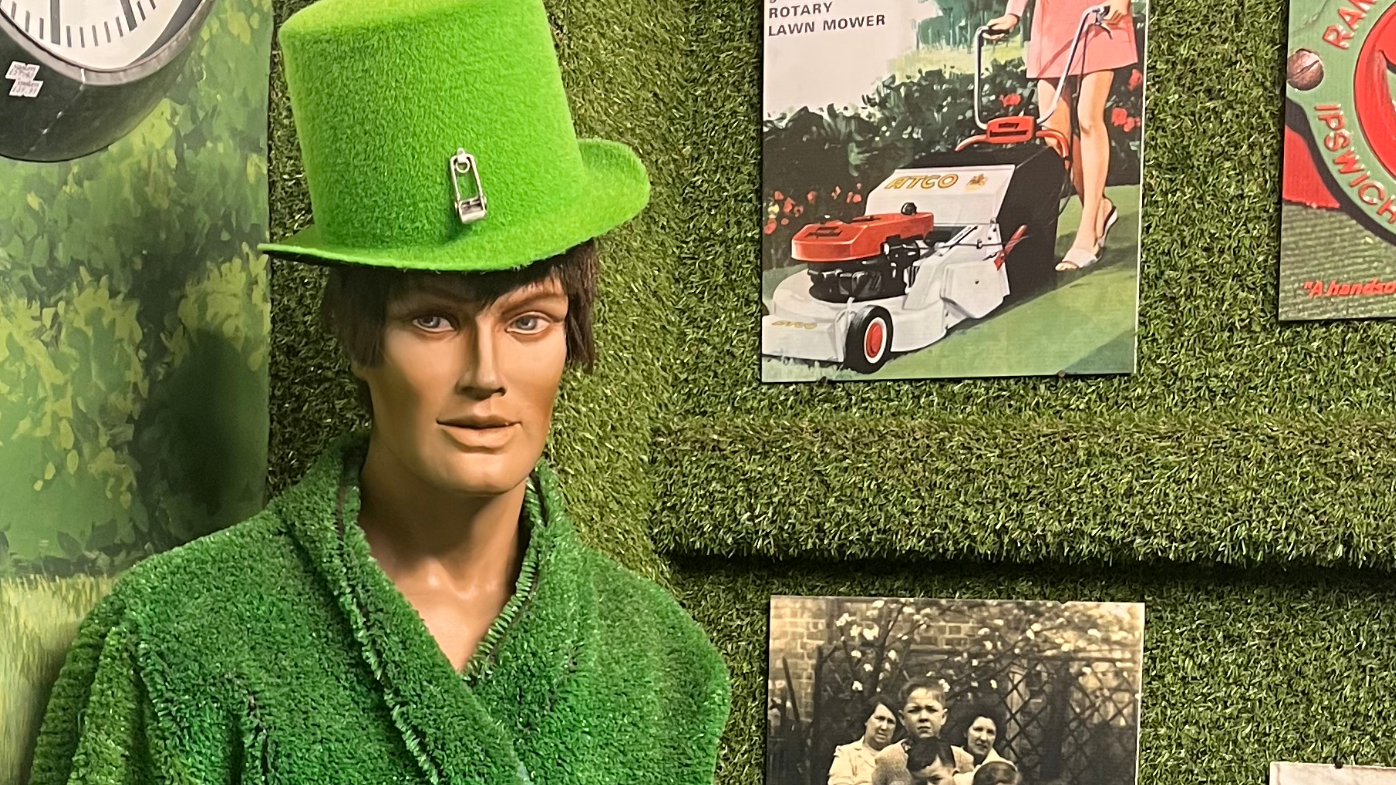
Lumbering through the turnstile, I’m faced by several hundred mean, green, grass-cutting machines. It’s like being inside a Homebase with plaques instead of prices. There are 200 on show and around 2000 more in storage. “We’ve got the biggest, the smallest, the most expensive, the fastest and the lawnmowers of the rich and famous,” Brian says.
He points out the first ever lawnmower, invented by Edward Beard Budding (of adjustable spanner fame) in 1830, adapted from his own machine that cut the tufts off pieces of cloth. “He found it cut grass very efficiently. So he started making this strange contraption. Everyone thought he was a lunatic,” Brian explains, noting that he used to test it out in the dead of night and ended up dying penniless.

And, like many British inventions, it peaked too quickly. “He got his design absolutely spot on. It’s still the best way of cutting a formal lawn if you want it pristine.” After getting an eyeful of Eric Morecambe’s lawnmower, we wind our way upstairs to the museum’s other rooms, stacked from floor to ceiling with horticultural paraphernalia.
In one, Brian gets very technical about the inner workings of a Flymo. Elsewhere, I’m shown a pair of leather boots, worn by horses that pulled early machines, donated by a 96-year-old local lady. “She said that the coachman didn’t want the horse to pee all over the freshly cut grass so he used to take it over to the bushes, do a whistle and the horse would relieve itself and fertilise the plants.”
More up my proverbial street is the pop culture ephemera on display. There’s a dibber from Lee Mack (who I’m told used to work at Red Rum’s stables round the corner); Lily Savage’s leopard print mower is on show; and even Princess Di donated her fancy Atco, a wedding present. It’s all so quintessentially eccentric and British, fodder for intrepid Anglophiles. I half expect Noel Edmonds to jump out the corner brandishing a Mr Blobby garden gnome.
Sadly, this doesn’t transpire; but things do get strange for a second. Brian points out a model of lawnmower owned by Albert Pierrepoint, Britain’s most storied hangman. It dangles on a noose. “He got £15 per execution and his lawn mower cost him £15. We always wondered who paid for it,” he says with a rye smile. And then I’m introduced to the type of toy grasscutter owned by Prince Andrew. “It was to encourage a child to cut the grass, just like Dad would do.” Ironically, I begin to sweat.
Brian is an excellent tour guide and raconteur. Equipped with patter, he spins yarns about horses kicking Monty Don in “the privates”, giving Lewis Hamilton advice on increasing his speed, and how scythemen used to have lick sawdust from each other’s eyes. A wall of fame shows the many photo-ops he’s landed with a who’s-who of teatime-telly-adjacent British celebs, from Jamie Oliver to Fiona Bruce.
But he also understands that it’s not a “sexy” topic. Or, increasingly, a relevant one. Fewer people actually have access to a garden and many folk are getting an artificial lawn instead, something Brian laments. “Grass is a magical plant,” he says. Tech has also spoiled things. “The robots are on their way” he says, as we inspect a cutting-edge, solar-panel-powered model which cost £1m to make but is now out of service and gathering dust.

In a sense, the lawnmower is a symbol of an old Britain – one that had both cutting-edge industry and bucolic countryside. Now, we have empty factories and bulldozed green spaces. I’m allergic to patriotism and, as previously mentioned, haven’t spared a thought for lawnmowers before – but I can at least understand an element of the romance of it.
Throughout the tour, Brian notes that most of the manufacturers don’t make them like they used to anymore. It builds up to his concluding statement, an epitaph of sorts. “It’s a bit of British heritage we’ve lost,” he says. Armed with a handful of pamphlets, I exit (regrettably, there is no gift shop) and saunter back down towards the station. Just around the corner, I happen to pass EnviroLawn: a shop selling artificial grass. I scowl.
On the journey back to Manchester, I gaze out the window, as the train passes rows of unkempt weeds and shaggy grass, lazily wilting over the tracks. Perhaps, in the near future, there won’t be a single person thinking about lawnmowers. But, as long as The British Lawnmower Museum survives, there will be at least one: Brian, the king of Lawnmowerworld.
You must be logged in to post a comment.