
Embedded in me is the landscape of dilapidation. By the time I was growing up in the 90s, the slag heaps and epic quantities of derelict land Ashton-in-Makerfield was famed for had been levelled and greened. I wasn’t negotiating the vast lunar landscapes of the 70s but the smaller pockets of ruination leftover. Dreamlike sites of abandon described by Richard Mabey as “the unofficial countryside”; wild cut throughs lined with three-metre-high Japanese knotweed, the pervasiveness of dusty unadopted roads, old train lines and their partially collapsed pedestrian bridges, and the tiled floors of an exploded ice cream factory just visible through the dandelions in the grouting.
Even weekend trips back to my parents’ native Liverpool involved quiet moments parked up on the old dock road, taking in the deindustrial desert. My dad and I shared a silence pockmarked only by seagulls splitting the air over the Mersey. I suspect he was heavily influenced into these poignant moments, sitting in his worn out Escort, by an episode of 1982’s Boys From the Blackstuff. “George’s Last Ride” features Dennis Kerrigan (as George) taking a last look at Liverpool before dying. Wet-eyed, wistful and angry, he bemoans the decimation of the docks, the unemployment… and I wonder now whether my dad was repeating George’s monologue to himself as we sat idle, staring across the rubble. On the TV screen in his mind George is getting to the line: “I can’t believe that there’s no hope. I can’t!”

“George’s Last Ride”, Boys from the Blackstuff (1982)
And sure enough, all that was debris later became hope. The built environment was revived. Despite my romantic backward glances out across industrial wastelands, I wished for a hopeful future; I wanted contaminated land remediated and family homes built on the ice cream factory floor.
I found new sites to love when I moved to Manchester, the former docklands at Pomona with its own floor tiles secreted under the brambles and sea buckthorn. I liked to investigate the recently vacant buildings, and my social life relied on the affordable cultural spaces made in old mills and warehouses. That was 2007 and the same vacant buildings are anything but winsome now; today hope has been sold to a foreign investor. I can think of few places that demonstrate wilful neglect quite the way Manchester does.
The timeline of Manchester’s drastic change is roughly delineated by industrialisation, war and the post-war period, deindustrialisation, and today’s postindustrial Society of the Spectacle theme park era. Each period has been through amorphous change, seeing the decline of one particular built environment in favour of another. Industrialisation saw the old city practically rebuilt, creating a streetscape of warehouses, mills and ornate wealth signifiers such as Ship Canal House or its neighbour, 100 King Street. The post-war period bulldozed the slum housing that industry had necessitated, but the welfare state was unable to keep up with its own ethos of renewal – as it turns out, knocking down houses is much quicker than building new ones. Deindustrialisation overlapped with the post-war era, and shared similar development goals, another consistent of both periods was the quiet buying up of public land by the Arndale Property Trust. To actually get the Arndale built involved colluding with the media and central government to create a race-based moral panic, and the subsequent passing of a new law (Manchester Corporation Act 1965) which allowed venues to be closed if deemed unsafe, unsanitary, or unArndale. The whole historic area closed down in a handful of years, only then did the carefully curated let-them-crumble regime take hold. The shiny new Arndale was totemic of the wilful neglect movement beginning in earnest, it was offered as a better option than the decay it expedited, and it was a shining example of media complicity in regurgitating false timelines and hyperbolic crime reports to benefit property developers.

In the early 1980s the city centre population was imperceptible; somewhere between 250 and 1,000 residents, and the absence of eyes on the street allowed for communities who were discriminated against to build a home. Canal Street, though still patrolled, targeted, and criminalised, grew like rhubarb in the dark nourished by long-term vacancy, and the inertia of landbanking (the practice of purchasing land cheaply and keeping it vacant for prolonged periods of time until reaching an investment zenith. Surface level car parks scream landbanking).
In the 1930s before the city actually willed its buildings to fall down, a big worry was: “OMG, what if all our buildings fall down?!”, and the warehouses surrounding the Gay Village were of particular concern, yet the very idea of city centre living in such a bleak, depopulated place was inconceivable. That was until a marginalised community klaxon blared through the corridors of the town hall in the 70s: “Why don’t we put people there who have no choice!”

(source: Manchester Libraries)
On one hand, Allan Roberts – the youngest Chair of Housing in the history of Manchester Council – led a radical housing policy and was the first to believe in city living. But on the other hand, could it be that his visions were only implemented because it was deemed low risk to gamble with the long-term housing security of immigrants and the working class? Council houses were built on the Arndale roof, on the ruins of the Smithfield markets, and warehouses were adapted for living within the Whitworth Conservation Zone. I see their inhabitants – the LGBTQ+ community, the Chinese population, and the working class as a large-scale property guardianship programme, keeping things ticking over throughout the 80s and 90s until the real residents move in. After all, it’s common global practice for sexual “others” to be conscripted into the process of urban transformation, so why not the low waged, the no waged, and the not-whites? By 2001, a survey revealed that a quarter of city centre households were gay men and “loft living” was suddenly desirable. Property developers, the biggest threat to gay neighbourhoods, would soon erode and attempt to erase the burgeoning community. The Council has since referred to the Gay Village by made up monikers skirting around queerness, such as: “Whitworth – the village in the city!”, and “Portland Village”, and new developments such as Kampus by Capital and Centric, or Watch This Space’s family homes for locals only (AKA foreign-owned full time Airbnbs) on Richmond Street describe their sites as “a canalside piazza close to Whitworth Housing Village”, and being “near a famous canal”. It’s telling in the timeline of moral panics and escalated crime headlines, that I spot police patrolling the Gay Village exponentially more often than in the Northern Quarter. It brings to mind Greater Manchester Police’s Operation Vulcan (named after a war time ground attack campaign in Tunisia) which since 2022 has leveraged counterfeit operations and racial tensions as a land clearance tool for property developers. GMP defines Vulcan as “the multi-agency operation which blitzed the infamous area of Cheetham Hill and Strangeways”. Whilst the Gay Village is unlikely to be “blitzed”, the police presence feels familiarly loaded. More subtly, the working class Northern Quarter residents have been displaced by the knock on effect of Thatcher’s Right To Buy scheme which sees many of the council homes now operating as Airbnbs owned by influencer accommodation specialist Luxury Opulence Living.
Perhaps a defining moment in the great what-can-we-get-away-with winter of deindustrialisation was in the 1993 disappearance of Tommy Duck’s pub over by St Peter’s Square. Rather than set the wheels of declination in motion, this time they’d take swifter action. The same Friday night a preservation order expired on the pub, the brewery had it demolished (before it could be renewed the coming Monday). The landlord had had a few days’ notice, but to the rest of the city it was a legendary low blow. It was ruled at an inquiry to have “completely ignored legislation”, and I’m sure that mild telling off really made the multi-millionaires think about what they’d done. After the public backlash, developers and landlords settled back into the tried and tested combination of landbanking and decline, whilst they steadfastly prayed for the spontaneous combustion of their assets.
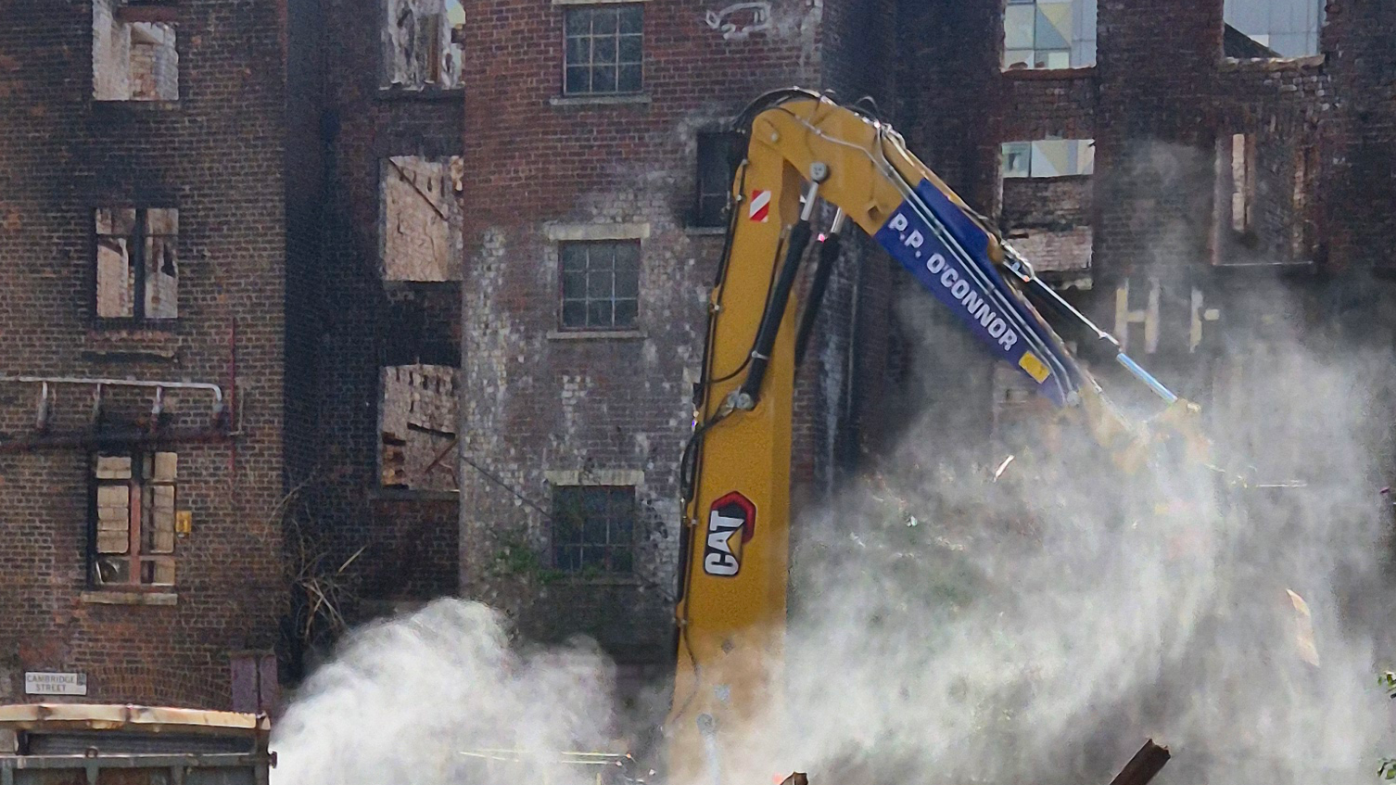
In June this year, much loved Hotspur House burned down. I’d been in a cab across town when the burning smell filled my nose and even when I couldn’t see for smoke, I knew it was Hotspur. The shell of what remains is being dismantled day by day. Mainstream media coverage supported the developer’s rhetoric that it had been decaying and vacant “for decades”. Tell that to the artists who were still active tenants in 2017. This was the same tactic deployed by Capital and Centric at Crusader in 2016. Whilst there was an acknowledgement of the artists’ studios, the seven long-standing South Asian textile firms were replaced by a white saviour rhetoric and past tense vomit such as: “it’s pretty cool that Crusader used to be a textile mill – it’s even cooler that we’re turning the courtyard into a secret garden just for you”. I suppose “it’s pretty cool we started sandblasting inside and ruined all their machinery putting many out of business before evicting the rest” wasn’t signed off by marketing.

After Hotspur burned down, the architect Stephen Hodder pointed the finger at those who campaigned to have it listed and thus, in his eyes, prevented redevelopment. Who was pointing the fingers at the developers (Manner) when they opened it up for pigeons to create a Jackson Pollock-inspired literal shit show inside? Who was pointing at them when they launched a heavily marketed campaign to Save Hotspur Press which banked on misleading followers into support? People followed the account, which had no posts except sponsored ads, people clicked through and signed the petition to save the building they loved, but few of those people read the blurb which revealed what they were saving it from was being saved. It was a petition against preservation and it was run by the developers. The media again supported the narrative with the M.E.N. headline: “Historic Hotspur Press mill to be saved after government doesn’t list building.”
Elsewhere, 44 Portland Street was acquired in 2021 by NW Group Ltd. A listed building “ready for immediate development”. When it was on the market it was secure and in decent nick. Then immediately after it was sold, almost every window was indefinitely flung open. Inside, right now, pigeons are busy redecorating. Sometimes the open windows might entice teenagers, urban explorers, the unhoused, and there’s your failsafe excuse if the building happens to burn down. Preemptive evictions can form the beginning of a neglect campaign too. The venue Tiger Lounge closed down in 2017 so that the 19th century Freemasons building could be made into apartments. As of 2025, no work has started. Most famous in recent years was London Road fire station’s near-30 year dormancy at the hands of owners Britannia Hotels. Although a compulsory purchase order (CPO) was eventually passed in 2015 and Allied London have been slowly redeveloping ever since, it’s hard to not be sceptical of why the CPO passed when it did (besides pressure from a campaign group). Living in Manchester means that even when the Council does the right thing, you expect to find out it was for the wrong reason.
The property industry is plagued by ill will. There’s all sorts of weaponised incompetence on the table. Box ticking public consultations which are announced last minute, or in the case of Renolds Corner by Group D Architects, residents were hand-delivered flyers three days after it’d taken place. Less brazen are those scheduled during typical working hours, or in spaces that would intimidate. A Soap Street consultation by Salboy in 2018 gave residents the chance to see the plans, and to eventually draw out of the developers the news that it was actually being demolished the next morning – the Tommy Ducks of the 21st century. Soap Street, like many of these examples, falls within a conservation zone, an entirely meaningless concept in Manchester. The adjoining building had been demolished in similar haste a few months prior as an emergency measure owing to negligence on the part of the owner – only this time the Council was that negligent owner and served themselves the Dangerous Buildings Notice. Perhaps this is all an avant garde strategy of power, a means to bamboozle us out of action and into ambivalence.

Not dissimilar was the 2019 story of a row of buildings on Thomas Street. Purchased in 1962 by landbanker extraordinaire, Agecroft, the landlord allowed the Asian rag trade workers to remain as tenants, but from 1982 the site was quietly removed from the market and has stood empty since. As testament to the fact there is almost no discernable difference between property developers and Manchester City Council, Frank Westbrook, the man behind Agecroft at the time, was father of the mayor. Thomas Street was also served a dangerous buildings notice. When served, the notice offers the property owner a choice: make the building safe immediately, or you know, if you fancy, just knock it down.
We all knew a fire was coming to Hotspur, and I’ll add to my risk list Stowell’s umbrella and cane factory at Shudehill, anything not nailed down in the Northern Quarter, the entire New Cross area, in particular buildings clustered around Mason Street, and another old umbrella factory on Cable Street which bucks and curves like our leaning tower of Pisa and whose fate is foreshadowed by the surface level car park of the apocalypse next door.
EDITOR’S NOTE
As of 17th July 2025, less than a month following the blaze, GMP’s criminal investigation into the fire at Hotspur Press was closed due to the building’s “extremely dangerous” condition (source: Manchester evening news).
unless stated otherwise, all photographs courtesy of author
You must be logged in to post a comment.