
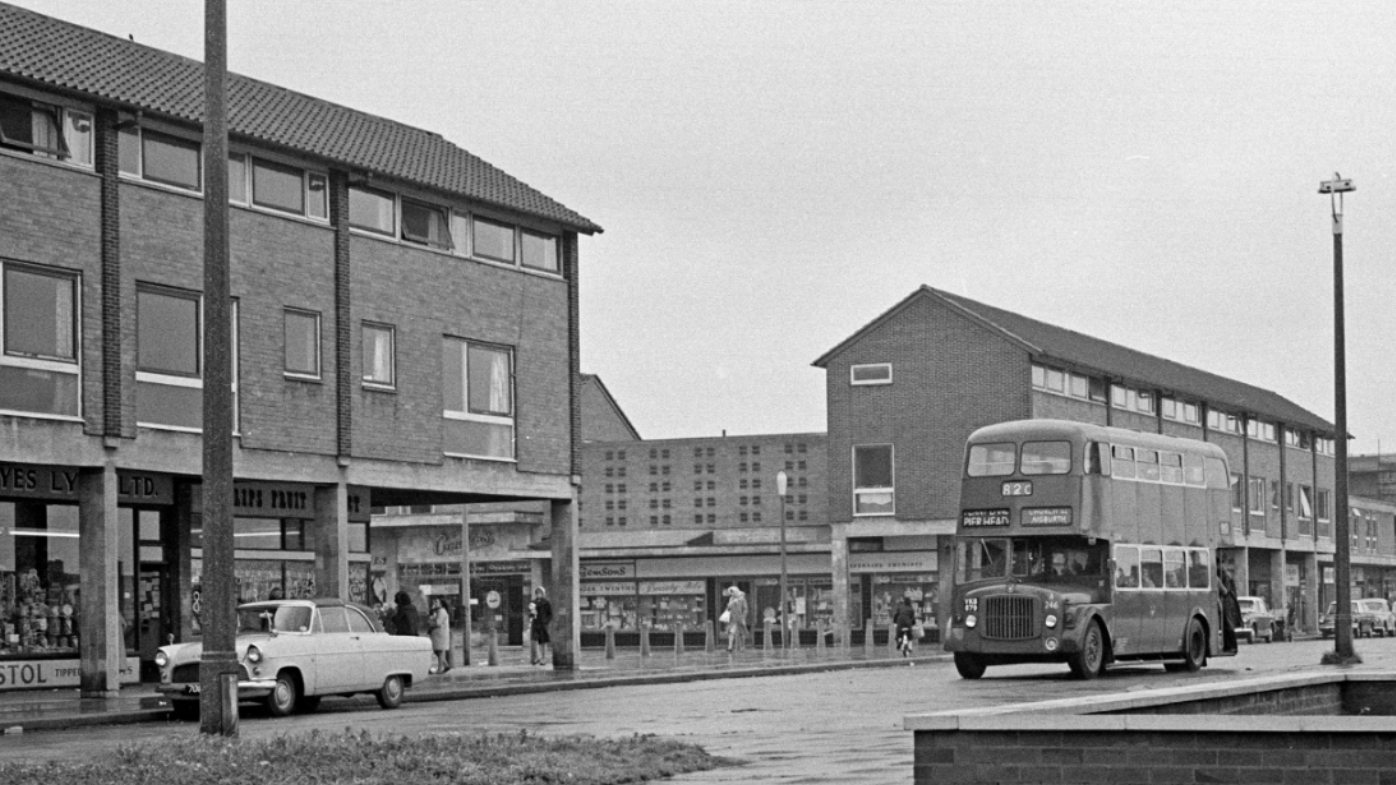
HEADER: South Parade, Speke (Eric James, 1963)
“But where are you, the Liverpool I knew and loved? Where have you gone without me?”
Terence Davies (1945 – 2023)
My grandma Joan was fascinated by the past. Her own past, her family’s past, Liverpool’s past. It was part of her essence, an indelible part of who she was. She spent her spare time writing about the past, first by hand or typewriter, then in Word documents on a laptop in the dining room, which she’d later print out (or more precisely, ask one of the more tech-literate members of the family to help her print out). When she passed away in June 2023, she left behind her writing in an airing cupboard in the upstairs spare bedroom of her home in Warrington. My family moved into the house a few months later, partly to keep an eye on my grandad’s health, and I was given the spare bedroom for whenever I’d return home.
I’d had a vague idea of editing what she had written into some kind of volume, a keepsake for the rest of the family to remember her by, so I began sorting through the assorted diaries, amateur histories, correspondences, and other miscellanies that sat in boxes in my room. I was soon struck by the difficulty of doing so; despite there being a somewhat consistent theme to the writing (family, place, pop culture), the topics were sporadic, even random at times. The lineage of her and my grandad’s families back to the Liverpool of the 1850s made sense, but the 750 words each on Portmeirion and Jersey felt marginal. However, this is what took her interest, and removing anything felt like an insult that would defeat the purpose of the project. Eventually it took me thinking about how her writing, her life, sat in the greater historical tapestry of Merseyside and Cheshire in the mid-20th century before it all came clear.
Joan Bell was born in North Wales in 1942, and would spend the early years of her life between the war-beleaguered Merseyside and a small hamlet in Anglesey where her extended family lived. She spent these years with her mother Dorothy, her father David being called up to fight in Burma. He would eventually return home to convalesce, and his experiences in the war remained a difficult topic for him to discuss.

The family would eventually settle on the Speke estate, a satellite town envisioned by the Liverpool Corporation to “accommodate all classes of the community”. It’s here that Joan lived much of her early life, and where the nostalgia of her writing truly starts to flow. Teddy boys, Elvis, Radio Luxembourg on a wireless in the hallway. It’s here she met my grandad, finished school and began her first job, and where she first experienced the fruits of the post-war consumer society.
Sir Lancelot Keay, the architect in charge of designing the Speke estate, had this to say about the ethos of his designs (I’m quoting here from the Municipal Dreams blog):
“[The people] should have the opportunity of enjoying all those excitements and pleasantries of life which are too often reserved for those in the higher-income levels … It is most essential that we should endeavour to bring back a greater measure of gaiety into the lives of ordinary people.”
Thus the people of the Speke estate, my grandparents included, benefitted from the proliferation of new consumer goods (she relates how all the kids gathered outside their house in awe when an uncle arrived in a new car), and from the availability of well-paying work away from the crowded Liverpool docks – her dad worked at the Dunlops factory, a major employer for the estate.
The first page of her 1963 diary is adorned with a cutout featuring two lads who had lived on neighbouring streets to her – Paul McCartney and George Harrison. They’re an extreme example, sure, but they point to a sense that people from these estates needn’t tarry their lives away for poverty wages any longer, that a true working-class popular art was emerging from these streets. Things were, of course, far from that straightforward (as the late 1970s would show), but there was a sense of a broad mobility springing from the post-war consensus. Reading it in 2024, the vision of the North West that it depicts seems almost alien.
The decline of British industry would later devastate the fortunes of the Speke estate, and Thatcherite economic policy (in the form of the Speke Free Enterprise Zone) would not help. It would be the second-most deprived ward in the country by the 2000s, compared to Beirut and Sarajevo by politicians in the press. Its people were politically disenfranchised, no longer an upwardly mobile community but a transient population forced to rely on precarious shiftwork and rented housing. By this time, my grandma had married and moved to Warrington, which was rapidly growing to accommodate overspill from Liverpool and Manchester.
Shortly after her funeral, I started watching Terence Davies “Liverpool Trilogy”, particularly enamoured by Distant Voices, Still Lives, a period drama about a working-class Catholic family in inner-city Liverpool, and Of Time and the City, an elegiac film poem about Davies’ own experience growing up in the city. Like Davies, my grandma’s writing was centrally concerned with a way of life that no longer existed, and the heady nostalgia that turns even times of strife and anguish into potently nostalgic memories.

Earlier this year, we made the drive to the hamlet of Llantrisant in Anglesey, where Joan’s ancestors lived. We took her ashes to scatter near the farmhouse where she spent her time during the war. Beyond the hamlet, across farmer’s fields and over a stile adorned with lilac, sat the abandoned Church of the Three Saints. Her own grandparents were buried in the graveyard here, extant since the 12th century and unused since the 1970s. We had to climb over an old stone wall to get in there. Far from civilization, from a modernity that had rendered it obsolete, this place still stood sentinel over the history of ordinary folk stretching far back into this island’s past. We left some of her there, in the world she loved.
You must be logged in to post a comment.