
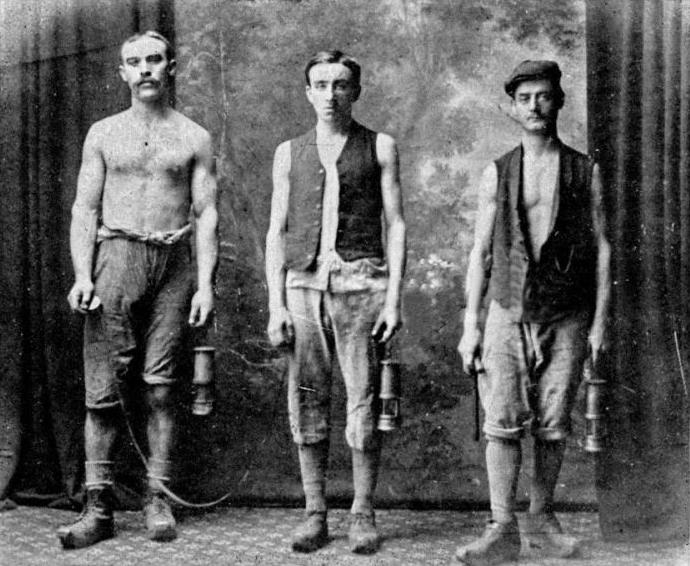
At just after 5pm on 18th August 1908, disaster struck the Maypole Colliery in Abram as a huge explosion ripped through the mine. The force of the blast destroyed the pit headgear, and shattered a two ft thick brick wall into atoms. Plumes of soot and ash were shot a hundred feet into the air and houses for miles around were shaken. 75 men were killed that day, most of them from Wigan and the surrounding area – many of whom had recently arrived from County Mayo, Ireland.
Among the only three survivors was my great grandfather, Edward Farrell, along with his workmates, William Doran and Richard Fairhurst. They miraculously survived by crawling for hundreds of yards underground and seeking refuge in a manhole where they were eventually rescued. They formed makeshift breathing apparatus with their vests soaked in tea to filter out the poisonous air.
Among the only three survivors was my great grandfather…
The pithead was crowded with thousands of locals who had congregated in the hope they would see their loved ones safely emerge. And emerge they did – exhausted, bruised, burned, and gassed knowing that 75 of their colleagues – many of them close friends – had perished in the blast. Wigan awoke to 44 new widows, 100 fatherless children, and 1100 men out of work. The mine was closed for three months as one hundred million gallons of water was poured into the pit to quell the fires that still raged on underground.
Just one week after the disaster, it was arranged for the three survivors to travel down to London to appear on stage at various music halls, in an effort to plead for subscriptions for families affected by the tragedy. However, my great-grandfather Edward was absent from the appearance. It was reported that he had shown signs of “mental weakness” due to the accident and had to be placed under restraint. Edward denied these claims, attributing his absence to a bad back. Nevertheless, it’s reasonable to assume that he must have suffered some traumatic stress as a result of the disaster. Later in life he developed claustrophobia, became withdrawn, and was generally reluctant to recall the events of that day.

Mental distress reporting among miners was scarce throughout the 19th and 20th centuries due to several factors. The machismo working culture generated by miners themselves discouraged open discussions about mental health. There was also fear of job loss as many Friendly Societies refused to pay benefits for “insanity”. Doctors would often collude with patients to exclude diagnoses suggestive of mental disorder, attributing psychological disturbances to physical illnesses instead.
“Wigan awoke to 44 new widows, 100 fatherless children, and 1100 men out of work”
The introduction of the Workmen’s Compensation Act in 1897 created an anxiety amongst employers regarding malingering – conscious simulation of symptoms in order to deceive. Rather than educate miners about the possible psychological consequences of experiencing a traumatic event, the attitude was to try and conceal this for fear that miners would exploit it. Doctors T.D. Spencer and D.B. Cook, for example, wrote to the chief medical officer of the National Coal Board, urging that the requirement to specify skull fractures be removed.
Both doctors felt that such fractures gave little indication as to the severity of the head injury, yet news of such an injury had “a profound psychological effect” in the affected miner. This not only hindered recovery, but “knowledge of a fractured skull may produce prolonged invalidism in the patient, especially if encouraged by his union.” The impact of such hardships transcended generations and many former mining communities still face mental health challenges today. Research conducted by The University of Cambridge in June 2021 revealed that self-reported mental health issues were significantly lower in former mining communities than in similarly deprived areas. Suicide rates in former coal-mining areas such as the North West, South West, Wales and Yorkshire/The Humber remain alarmingly high.

Image credit: Public Domain
Original fundraiser postcard from 1908 by Gothard of Barnsley
While deindustrialisation and the subsequent economic decline of former mining areas has contributed to the mental well-being of its people, the habit of not reporting mental distress – bottling up your emotions – may have perpetuated the mental health crisis.
Edward Farrell married two years later and had nine children, continuing to work at the Maypole Colliery until 1939 – just a year before he passed at fifty-six years old. He and his friends were the lucky ones having survived, but were forced to keep on surviving in unimaginably tough conditions to provide for their families. I wouldn’t be here today if it wasn’t for his resilience, and for that I am immensely proud.
It sickens me to learn of the troubles these people endured and that former mining communities are still affected to this day. In the modern world we continue to confront challenges, including the aftermath of the pandemic, the housing crisis, cost of living crisis, and climate collapse. These lessons from history can serve as a poignant reminder to prioritise mental health and to support each other – to offer solidarity – during difficult times.
You must be logged in to post a comment.