
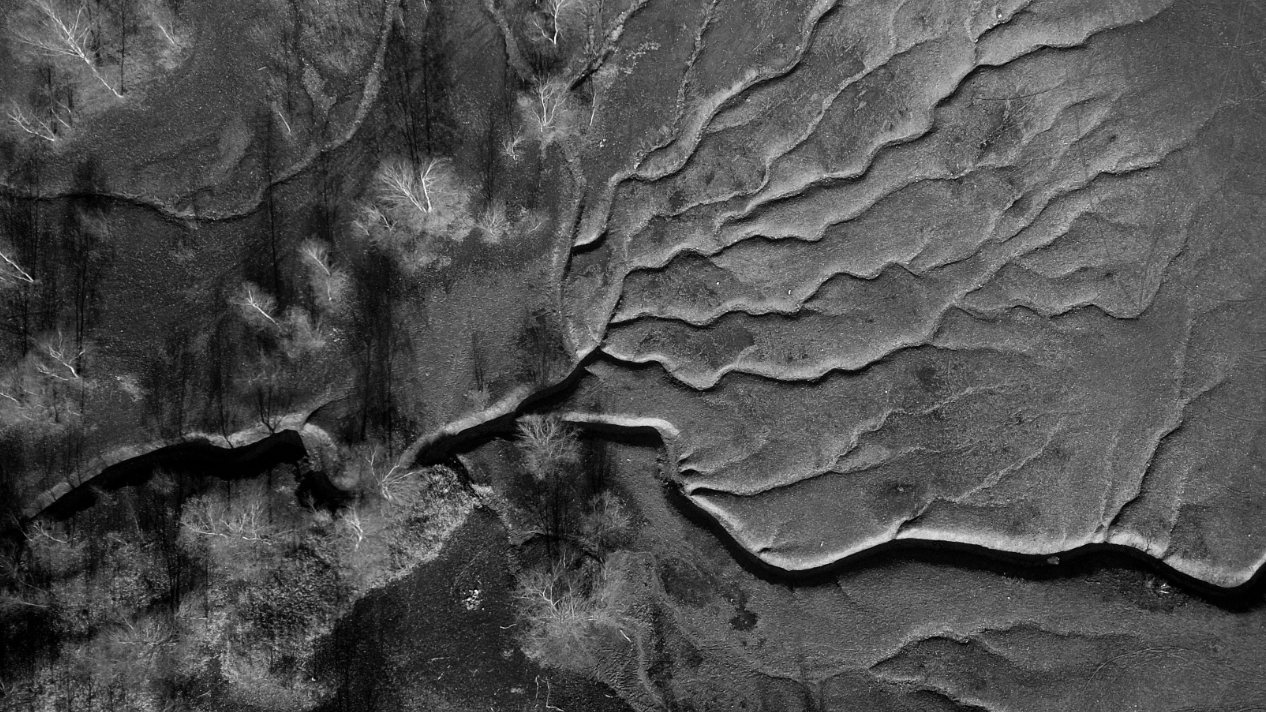
When the pandemic began, like many people, my relationship with landscape contracted and intensified. Through March to May, I saw the hawthorn fizz into flower, and I weaved through carpets of bluebells Iʼd overlooked in previous springs, in favour of travelling out to more traditional ʻhoney potʼ locations.
My evening strolls tended to start and end with a walk across the Gidlow coal wash. Sat between Standish to the north and Shevington to the west, it is an edgeland. Or what urban designer Alan Berger pleasingly refers to as a ʻDrosscapeʼ. In my repetition of the journey across the wash, I found the benefit of a repetitive relationship with a place is that it allows you to concentrate your focus on a landscape. An adjustment of scale that might more hopefully be looked at as an aperture rather than a boundary.

Gidlow coal wash can seem stark and depleted, but almost Icelandic in its monochrome palette and a product of geological upheaval just as geologically interesting. However, the coal wash is distinctly anthropogenic in its topography (or to put a finer point on it, ʻcapitalogenicʼ), a meeting of natural and social processes. Itʼs a place for illicit, transgressive, and morally dubious activity – from the carbon industries to the present day. Here you can see a tangle of tyre marks, burnt out cars and an inordinate amount of lighter fuel canisters being reclaimed by the soft shaley ground; a fossil fuel re-entering the fossil record in a concise picture of human intervention in the carbon cycle.
It would be far from most peopleʼs idea of an Arcadia. The spoils of industry are flagrant, washery waste leaches out of the ground and deep into the groundwater. And yet, the wash is not a salted earth.
Creeping in the from the periphery of the wash are birch trees. A pioneer species, birch trees provide an ecosystem service and have an amazing ability to reclaim spaces. They grow in poor soil, fixing nitrogen in their roots, improving the fertility of the ground and turning it in to a rich woodland ecosystem. Where the birch trees have broken a trail, moss follows, which has incredible potential as a carbon capture and can stabilise the soil, intuitively providing what the land needs. In the summer you can find wild orchards and, in the autumn, an abundance of fungi. I think what is so interesting about this process of auto-rewilding, is that it exists due to this meeting of natural and social processes. Itʼs a story that lives within the landscape, a spatiotemporal entity.
I have a somewhat topophilic relationship with the wash (not in a sinister, ʻblood soilʼ kind of way, my roots in Wigan are as shallow as the trees on the wash) but an affection for the layered history that comes together to make this place distinctive, a love for itʼs strange, idiosyncratic beauty. Much of what makes itʼs home here is an unintended consequence of a human-engineered space. Not necessarily a Bob Ross-style ʻhappy little accidentʼ, but not an entirely unhappy one either. Post-industrial ecologies are the fabled ʻliminal spacesʼ and perhaps the wash is at the nadir of two trajectories. The coal wash might remind us that landscapes exist in time, so may better looked at as a process.
I donʼt know what will happen to the coal wash, from what I gather there is some desire with in the local community for it to be redeveloped as a nature reserve. Iʼm not here to prescribe anything, but I suppose my point here is that a redevelopment process is already underway.
The wash might be implacable to our eye that is trained to a landscaped idea of the picturesque. In this sense, the way the trees are recolonising the land feels transgressive. Theyʼve not been invited by a committee and theyʼve defined a path before a planner can proscribe one for them.

Looking at the wash from this perspective, Iʼve paused to consider what we perceive as wild space. Post-industrial ecologies seem to be dynamic, ungoverned spaces, as opposed to national parks and rural spaces, which can often be prim, groomed and ecologically constrained. Iʼm not looking to pour scorn on national parks or rural places, theyʼre special places and I get of lot of joy from them. Nonetheless, the wash raises questions about the pictorial conventions of landscape photography. Is the aesthetic preference for the received idea of the picturesque always useful? Is our paternalistic approach to land beneficial? Central to our understanding of the Anthropocene is that humans are disrupting ecosystems beyond their capacity to adapt. For me, the charm of the coal wash lies in its new ʻferalʼ ecology ‒ one that has made its place on account of being ignored.
The roots of the birch trees winding into the wash serve as a reminder of the knotted interactions between human and non-humans and how they come together to form a landscape. It also shows how the natural world can reassert itself once humans relax their hold on things.
photographs courtesy of the author
Further Reading
A project led by over 79 scientists and artists show you how to recognise “feral” ecologies, encouraged by human-built infrastructures, but which have developed and spread beyond human control.
Edgelands
Paul Farley and Michael Roberts (2012)
Against the Anthropocene: Visual Culture and the Environment Today
T.J Demos (2017)
You must be logged in to post a comment.