
All photographs author’s own.
Content Warning
discussion of homelessness and child trafficking
At 57 years old, I never thought I’d be shitting myself knocking on the door of a squat. But life has a funny way of opening new doors, whether you’re squatting or shitting.
In 2017 I found myself visiting Hulme on a regular basis; my daughter had just started at Manchester Metropolitan. I came across a story online about how the Hulme Hippodrome theatre – a Victorian music hall built in 1901 – was now home to a group of squatters. Not used for its intended purpose since the 60s, the new occupiers were cleaning it up, keen to open a “community cafe” along with other bright-eyed ideas. They said people were welcome to come and take pictures inside. Within a few minutes I’d found one of the squatters on Facebook and I messaged him asking if I could photograph the building. A minute later – ping! “Yeah no problem.”
I’d not given it much thought. I’d never been in a squat, never met a squatter. Am I a bit mad going on my own? I thought. The speed of the reply unnerved me a bit. The more I thought about it the more mental it seemed. Two days later I was on Warwick Street in Hulme trying to work out how you get in the building.
You see, it doesn’t look like a theatre from the outside – it’s an enormous structure containing two conjoined theatres: the Hippodrome and the Playhouse. I knew the Hippodrome was at the back, but it was all boarded up. Hearing voices from behind a fire door, I knocked on it a few times.
“Yeah, what do you want?” someone shouted from behind the door 20 seconds later.
“I’ve come to meet Syd,” I replied.
The door unlocked and opened, just wide enough for a man’s head to pop around. He looked at me for a few seconds and told me loudly he “Don’t know no Syd!” He went back in, leaving the door ajar. I started to think it was a bad idea. I didn’t know who these people were – they could be real mad fuckers for all I know. Did Syd even exist?

“Hello!” someone shouted through the door, now fully open. There was Syd, about mid-20s with short dreadlocks. I recognised him from the pictures online. He let me in and I followed him. I had expected to enter the auditorium but instead I was in a big room. At the far end there was a small stage with a drum kit and PA speakers on either side. Large, differently coloured letters spelt out END WAR on the stage. A guy sat on a settee said hello. Syd asked if I wanted any of their food – a massive selection of artisan breads they’d got out a Waitrose skip. The friendly settee guy said it made a change from bloody pizza. They asked if I needed any camera batteries charging and if I wanted a brew. What a relief. I didn’t really know what to expect as a 57-year-old noseying around a squat, but it wasn’t hospitality.
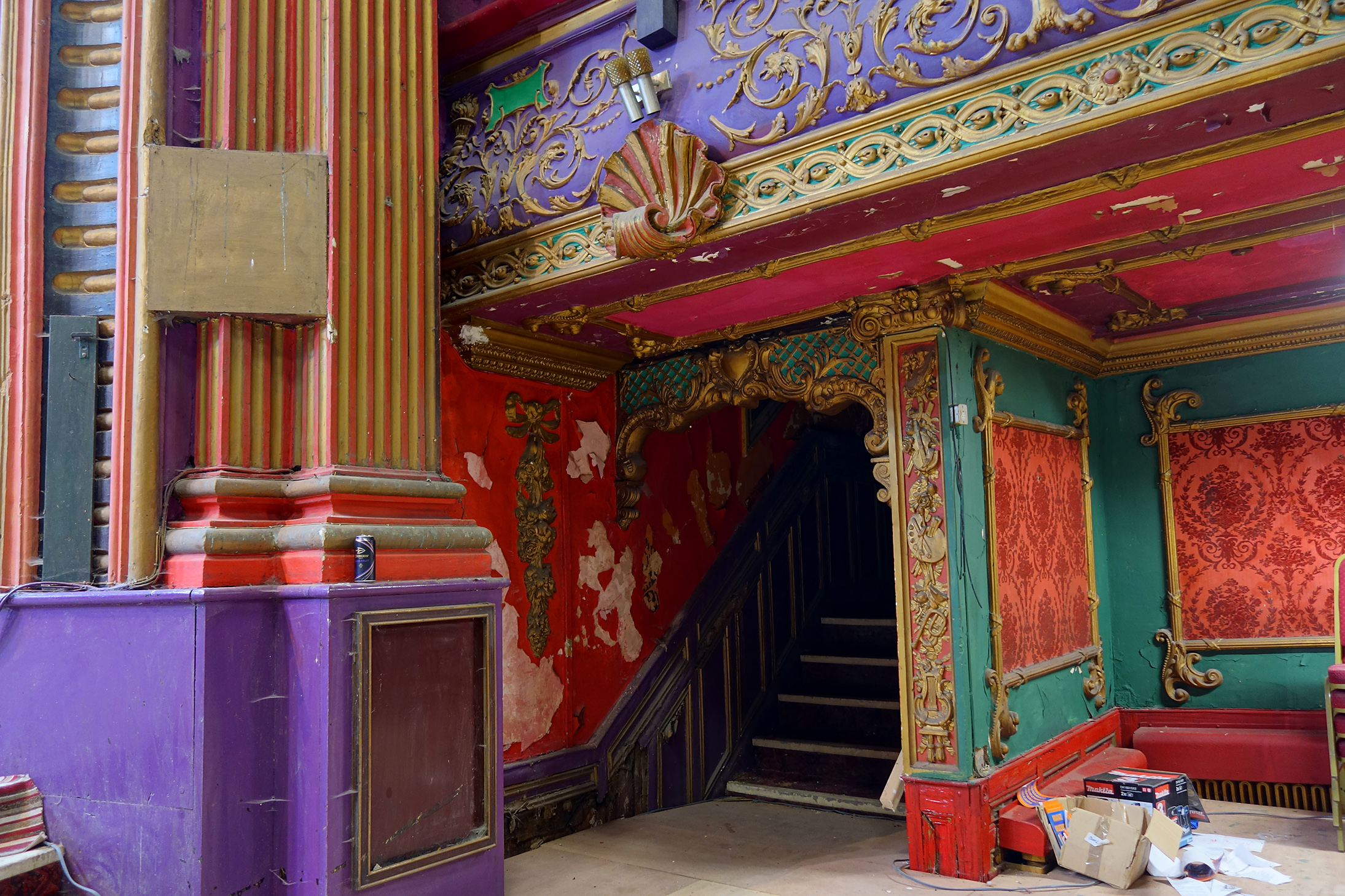
“I’ll show you the theatre then,” said Syd, ushering me through a dimly lit corridor that led to the auditorium. It was massive. Grand architecture and exceptional craftsmanship covered every available surface. Through the dust and shadows, I could see shy hues of luxurious red, gold and green.


He told me to exit the same way we’d come in and he left me to it. All the seats had been removed from the stalls and there was a scattering of modern fold-up chairs on new chipboard flooring. I walked across the stage to a staircase. I went up slowly, gilded rococo plasterwork of harps, trumpets, and artists’ palettes above my head. In the circle, I walked down a row of seats and stood in the centre aisle looking at the stage. It looked like Phantom of the Opera. I had a bad feeling being alone in that enormous space, but I started to realise I wasn’t. My eyes had adapted to the low light, and I’d spot the odd person walking through. I felt a bit bad about my initial worries – the people were nice and friendly, not a bunch of nutters.
I thought it’d be good to check out the box seats. A stack of chairs blocked the entrance, and as I started to move them I noticed an empty sleeping bag on the floor, along with a pair of trainers, a few carrier bags of belongings, and clothes folded on a chair. Someone’s sleeping space.

Right at that moment I knew that this was what I should be recording – homeless people living in a Victorian musical hall in the year of our Lord 2017. That’s the picture. Obviously it couldn’t be done without their permission, so it seemed a bit of a pipe dream. While in the stalls taking my pictures of the rococo plasterwork, a sudden “Alright there, mate?” boomed out from the dark. Shit. I looked around and there’s a guy sitting in the front row of the circle. He asked me if I’d seen below the stage and offered to give me a tour. This was Malc, a scouser in his late 20s who described himself as “not quite a squatter”, but he was good friends with some of those there that were.
“It’s very dark down there, and the steps are a bit treacherous,” Malc warned me as we headed down with the little torch I’d brought. He wasn’t kidding. It was pitch black as we negotiated the steep stone block steps. It was cold and damp and the steps were slippy with no handrail and the torch wasn’t very bright. All in all, a safety inspector’s worst nightmare. The bad feeling returned; the place felt like a mediaeval dungeon.
On reaching the bottom, Malc shone my torch through a doorway into a tiny space where a cheap, new-ish showerhead was dripping slowly onto the stone floor. Drip. Drip. “This is the first cell,” he said, “the only shower in the building, but not everyone will come down here.” No kidding. “It just gets worse and worse,” he went on. “When we first cracked the building, there were still the handprints of young children on the walls,” he explained, shining the dim torch up and down the walls, “We found shackles and all sorts down here.” At first I thought he was trying to scare me, but he proceeded to tell all about the building’s current owner: Gilbert Deya Ministries, a controversial church led by the miracle preacher Bishop Gilbert Deya, who claimed he could help infertile couples have “miracle babies.” Earlier that year, Denya had been extradited back to his native Kenya to address allegations of child theft, under the guise of performing miracles – accusations he denied. He had held a seven-day unusual miracles event at the Hippodrome in 2016. In one photo advert for his gospel CD, Deya wears a bishop’s pontifical vestments while the text “I AM NOT A CHILD TRAFFICKER” floats near his head. I was relieved when Malc shifted his focus away from the preacher and instead aimed the torch at a door with big red letters that read SWITCH ROOM KEEP OUT. The room was like a scene out of Metropolis, packed to the brim with old electrical equipment. I could hear a humming coming from next door – this one was labelled BATTERY ROOM KEEP OUT. “It’s OK, you’ll be completely safe out here,” Malc reassured me. He said that room was full of long tanks that had metal poles coming out of them, apparently containing 50 batteries that made the building self-sufficient. I’m not sure how true that was.


Calm now we’d made it alive back into the main theatre, Malc took me up to the gallery right at the very top, which only had wooden steps to sit on. These would have been the cheapest seats in the house and looked as if they hadn’t been used for a long time except for the odd pack of instant noodles.
After the guided tour I carried on filming and taking photographs. I was in my element. The thing about an interest in photography and video is you need something interesting to shoot, and this place was incredible. The Hippodrome is an iconic, Grade II listed building of social, historical, and architectural significance. I mean, you only need to look at the list of famous names that performed there: Harry Houdini, Stan Laurel, Max Miller, Gracie Fields, Frank Randle, George Formby, Morecambe and Wise, Tony Handcock , Ken Dodd, Nina Simone, and Shirley Bassey. All of them wowed and awed audiences sat in the seats now occupied by Pot Noodles.
After a few hours, I made my way back to the place I’d come in. Chatting with Syd over a coffee, he told me about the squatters’ plans for the building they’d spent several months restoring into a liveable state. Their aim was to turn it into a community cafe, venue, skill-sharing hub, soup kitchen, and possibly a library. I didn’t know how feasible all that was, but as Syd listed their plans all I could think about was the film – this would make a great film!
While we were talking, the Hippodrome had another visitor, this time unexpected. It was a guy – I think Eastern European – wearing a suit and carrying a leather briefcase. He was in Manchester looking for work and had nowhere to sleep. “Word soon gets round,” Syd told me. The squatters were only too happy to help if they could.

As I left the Hippodrome that afternoon I knew I’d be back. Imagine making a film about the place. Really imagine. I’d always wanted to have a go at filmmaking, but never got further than taping holidays and trips away with friends. Would they want to be filmed? Film or no film I was knocking on that fire escape door the following Thursday evening, still feeling a bit apprehensive. I wasn’t sure if the same people would still be there. Who knows how often squatters come and go?
“Who is it?” someone shouted from behind the door.
“It’s Dean, Syd invited me down.”
The door opened and I recognised the guy from before. He was warmer this time. He introduced himself as Ian. It was one of their jam nights, and Syd briefly introduced me to a group of 10 others – some from other local squats: one near Piccadilly Station and another on a disused adventure playground.
The more I visited the Hippodrome, the more I got to know people. Not just the squatters – some locals would stop by with food. I saw some touching acts of kindness. I remember an old guy that lived nearby used to call in for a cup of tea and natter. He was going into hospital for an operation on his stomach. He was worried about the fact he was sleeping on the floor of his flat and how continuing to do so might impact him after the op. On hearing this, one of the squatters gave him their mattress.
The idea of a film was on my mind the whole time. Each visit just left me more convinced how amazing it could be. But was I ever going to ask them? Honestly I was worried they’d say no. I remember the evening I asked Syd. I had gone round to the squat and the people I knew had gone out but were due back soon. I was let in and plonked myself on one of the sofas. After about 10 minutes, a group of them arrived back with rolled-up towels under their arms. I asked what they’d been up to. “Swimming.” Some of their friends had squatted in an abandoned swimming pool in Chorlton; it took them four days to refill it. They went down once a week for a swim and a sauna. I have got to film this, I thought to myself. I told Syd: “You know, you should be documenting all the stuff you’re doing in a film.” To my relief, he and Ian thought it was a good idea. I remember feeling electric when I left the squat that evening. One of the guys – Dinkie, who had a beautiful Staffordshire Bull Terrier called Coco – shouted to me as I was walking away. “Hey Dean, if we find out you’re a copper we’ll fuckin duff you in!”
I was a bit nervous; I had never made a documentary before. Having filmed gigs’ worth of b-roll inside the theatre, I needed interviews. Syd and Ian said they would speak on camera, so I focused on them. The Hippodrome has very few windows, so I bought some LED lights to make up for it. I arranged an interview with Syd in a few days’ time. I turned up at 9:30 am on the morning and one of the squatters was doing himself some toast in the kitchen. “Where’s Syd?’’ I asked. He pointed to the other side of the room. I looked but no one was there. As he motioned to take his toast I asked him again. He pointed – again – to the other side of the room towards the small stage. He wandered over towards the stage, me following the scent of his freshly-buttered toast. He pulled off a quilt from an old armchair, revealing Syd, who was startled and shielding his eyes.
“What the fuck do you want?” he groaned.
The interview.
“I’ve only just gone to bed, we’ll have to do it later,” he muttered before pulling the cover back over his head. With no daylight the squat did have a distinctly nocturnal atmosphere. With Toast Man gone and Syd bedded down for the morning, it wasn’t the start I’d imagined.
While scoping for potential interview locations, I met a guy called Pascal. He was a Black guy, late 30s, I think South African. He spoke about his affection for the people here and how he’d first met some members of the crew that had participated in an occupation of the Cornerhouse Cinema earlier that year. “I’d never seen such beautiful people, I wanted to be there all the time” he told me. After it was closed down he followed them to the Old Hotspur Press building. When that closed it broke his heart. Then he heard they’d found a big building: the Hippodrome. Oh my god, he thought, I used to play the piano there for the church.
I asked if he’d be up for an interview. Pascal insisted on holding an old acoustic guitar he found lying around that only had three strings. Despite my reservations about the guitar, he remained adamant. To avoid any bad feeling I didn’t push the matter. So much for my director skills. I asked him to start by telling me how he ended up playing piano for the church. As he spoke he started strumming the three atonal strings. I was monitoring the sound through headphones, and I could hear an intermittent knocking sound, which was either the guitar or the small beads he had round his neck knocking against the mic. Also, his English was somewhat broken, further complicated by the sudden emergence of a distinctive slow jazz vernacular in his speech, characterised by expressions such as “Arrrhhh yeh mannnn.” I knew instantly that this wasn’t going to make it into the film.

What drew Pascal to playing piano for the church was his desire to research how sounds could induce “trance-like states” in people. He was taught to play quietly, but the church wanted it loud. The way Pascal was brought up, you went to church to give thanks. But to Gilbert Deya Ministries, everything was evil. It was a deliverance church, he explained, meant to save people from demons and evil spirits. One parishioner told him his legs were due to be amputated before Bishop Deya prayed to heal them, and suddenly they started working again. Deya also did dental work and he’d even fixed up Pascal’s fillings. But Pascal wasn’t looking for miracles, he was self-employed and just wanted to play the piano. He was trained to play jazz, but they would always be telling him “you shouldn’t do this” and “you shouldn’t that”.
He was still playing piano for the church when the congregation had to vacate the building once it was classed as dangerous by the council. I think the last straw for Pascal was when a couple of church members from Birmingham went underground to trick him to give information about the new occupants. Pascal said the squatters in the Hippodrome were going to leave a very beautiful footprint. I never saw Pascal again after that interview. I was told by some that he was a very talented multi-instrumentalist. After hearing his three-string guitar, I’ll have to take their word.
I interviewed Syd 12 hours after the agreed time, but it was worth the wait. He spoke very well, covered the history of the building, and detailed what the squatters were trying to achieve. The interview with Ian never happened. He was a nice guy. He tried to get a food kitchen going for the homeless, but Hulme was too far out from Manchester for most, and the fire brigade weren’t keen on more people entering the building.
The final film includes footage of some of the live music events that I attended at the theatre: some Sunday afternoon reggae events, “Dub Cafe” and “Jam Pot” evenings where there were jam sessions, poetry nights, rap, etc. But the best ones were the events that just appeared on Syd’s Facebook at short notice. “Few bands on tonite. You know the place,” or “Secret gig at that place I’m always going on about. Saturday night btw, looking to be special.”
The first all-night one I attended had three bands: I am Six, Denim & Leather and Yo Dynamo, who let me use one of their tracks in the film. I had never been to anything like it. “Counterculture” is the only way I can describe the night. Chaos and creativity organised by a group of people surviving almost entirely outside the formal economy.

When I started editing footage, I had an idea for the opening titles. One early March morning in 2018, I filmed the big “Hulme” part of the Hulme Community Gardens sign adjacent to the Hippodrome. When I’d got the shots, I walked round and knocked on the squat door. For some reason it was taking them ages to answer. After a lot of knocking I heard a terse “Who is it?”
“Dean.”
“What do you want?”
Oh shit. Something felt wrong. Our exchange continued for some time, leading me to suspect it was a prank. Eventually, the door slid open and two unfamiliar young men stood in the frame. Hoping it would diffuse any tension, I mentioned that I was a friend of Syd’s. They informed me there had been an altercation and they had taken control of the building, assuring me that Syd was unharmed. I left and called him to see if he was alright. He told me he was fine and there had been a disagreement which prompted them to vacate. It was over. If only I had more time, I thought.
I eventually put a short film together and entered film festivals. To my surprise, it was selected for screening at several of them.
The Hulme Hippodrome was like a portal into another world, and it closed as quickly as it opened. Like Deya, Syd had been ousted before his mission could truly begin. And while I may have cut my teeth with filmmaking, I certainly had no fillings to show for it.

Save Hulme Hippodrome is a campaign group that aims to restore the building as a community resource for creative industries. You can find them here.
Occupying the Hulme Hippodrome is a short film by Dean Cooper, the author of this article, and can be viewed in full on Vimeo, here.
You must be logged in to post a comment.