
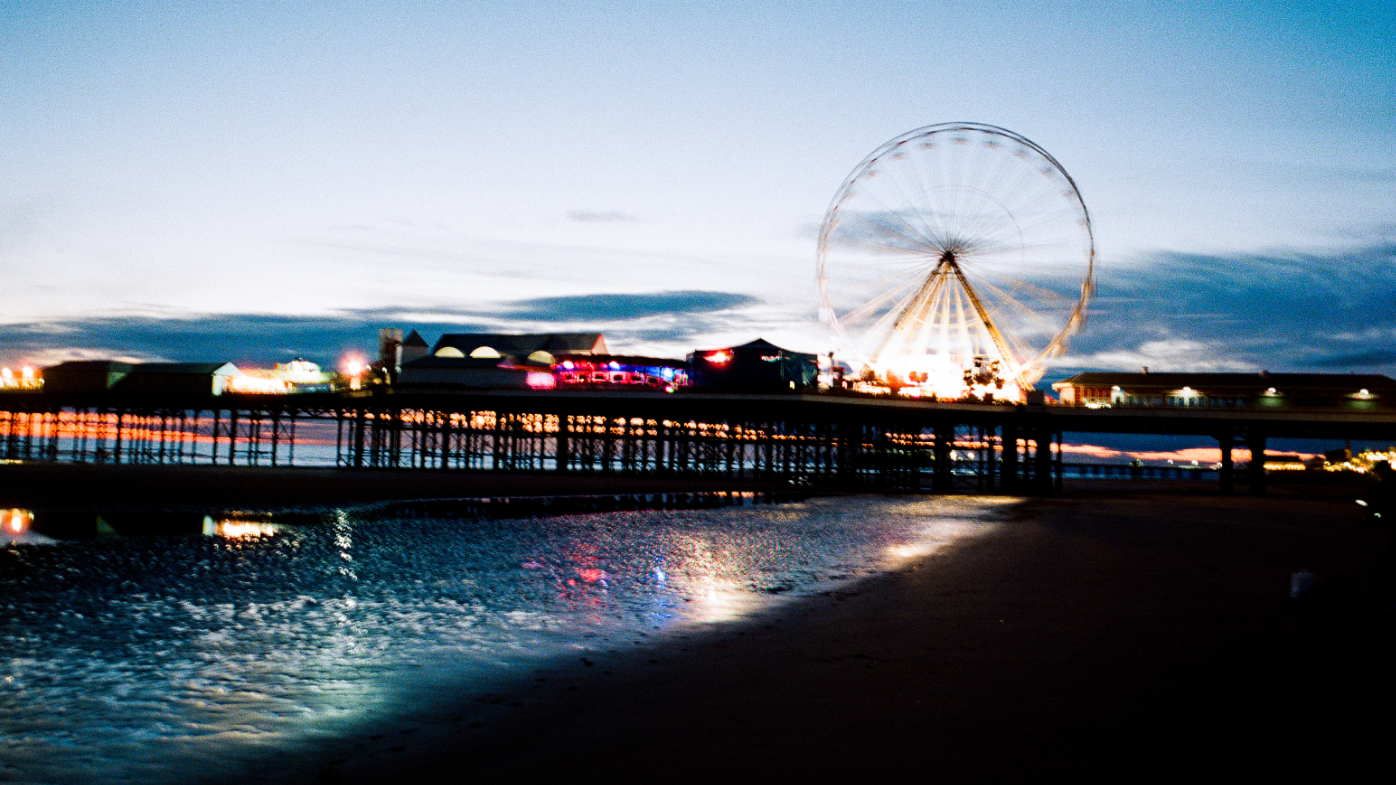
In the town of Blackpool, the promenade is a psychic scar where the tide of the 20th century refused to go out.
Birthed from the industrial womb of Salford’s The White Hotel, The Black Lights Festival is about to rewire the town’s nervous system. This isn’t a holiday; it’s a “migration of sound” across polished, salt-eaten surfaces.
From June 26th to 28th, 2026, the festival will seize the town’s crumbling glory, transforming heritage sites into high-voltage zones of excitement – a flare of sound and vision, where music, theatre, film, and visual arts collide with the accelerating pulse of a town obsessed with light and shadow.
To navigate this alternative reality, follow the ghost-frequency of the following nodes.

B&Bs
Blackpool’s B&Bs are a parallel universe of neon signs that say “VACANCIES” with a confidence bordering on threat. There are hundreds of them, stacked like playing cards along the streets, each one offering a bed, a breakfast and a highly specific worldview.
At the budget end: floral carpets, wallpaper that has survived several governments, and a landlady who can diagnose your moral character by how you take your tea. You will be asked what time you’re in. You will be told what time you’re out. You will be watched leaving.
At the other end: the Art B&B, where the concept of “a room” has been replaced by “an experience”. You sleep inside a sculpture, shower next to a manifesto, and wake up unsure if you’ve stayed in a hotel or been temporarily curated. The kettle may itself be an artwork. You must treat it with respect.
Between these extremes lies every price point, every comfort level, every degree of psychic intensity. Pick your budget, pick your fantasy, ring the bell, and step inside someone else’s version of how the world should be.

LYNDENE HOTEL
To arrive at the Lyndene Hotel is to confront a certain unapologetic permanence in the British coastal imagination. Situated on the Promenade with the practiced air of a seasoned regular, this 141-room establishment functions less as a lodging and more as a self-contained ecosystem of Northern festivity.
It doesn’t merely exist; it throbs. The lobby, a staging ground for what the hotel confidently bills as the resort’s premier entertainment, hums with the low-frequency vibration of mid-century glamour meeting modern-day stamina. One finds oneself navigating a landscape of sea-view lounges where the décor – crimson carpets and air-conditioned cabaret spaces – serves as a backdrop to a relentless schedule of variety. On any given evening, a visitor might witness a pincer movement of three to four separate acts: vocalists channelling the heavy-hitting catalogues of Bassey or Mercury, comedians of the old-school cadence, and the occasional tribute to ABBA, all overseen by a resident compere who keeps the evening’s momentum strictly regulated.
The décor? It’s a sensory blitzkrieg. It’s the Blackpool aesthetic pushed to its screaming, neon conclusion. You don’t just stay at the Lyndene; you succumb to it.

THE PINK POODLE
The Pink Poodle remains a vivid, twitching anomaly in the Blackpool ecosystem – a small, three-star fortress of empathy standing just a few salt-scoured blocks from the North Shore station. It is a pastel-hued bunker where the British B&B tradition has been radicalised by owners Lily and Gaz into a sanctuary of “good-humoured banter” and relentless, high-calorie hospitality.
This is the Blackpool of the marginalised and the bold, an adult-only refuge where the LGBTQ+ community find not just lodging, but a communal mission to “sort the world out” over an all-you-can-eat English breakfast.
The aesthetic is total; it is a blast of individualised décor and specifically calibrated lighting – designed, one suspects, with the surgical precision required for the heavy-duty application of makeup. The nine ensuite rooms are individually decorated, providing a cozy, if distinctively vivid, retreat from the surrounding resorts’ more raucous enticements.
Even the financial mechanics possess a layer of thoughtful, subterranean discretion – BACS transfers that vanish into the accounts of business partners to spare guests the neon glare of the Pink Poodle name on their bank statements. It is a place of safe harbour. The Poodle is still barking, still pink, and still offering a defiant, sequined middle finger to the beige indifference of the modern age.

ONLY TANS
It is a truth universally acknowledged that those in possession of a pale, Lancashire pallor must be in want of an ultraviolet resurrection. One stumbles through the salt-crusted gale of the Promenade, past the skeletal remains of the pier, and there – blazing like a radioactive orange in a bowl of grey porridge – sits Only Tans.
You enter, skin the colour of a wet envelope. The staff usher you toward the tubes of light with the solemnity of priests. You lie there, basted in coconut-scented hope, listening to the low thrum of the cosmos or perhaps just the ventilation system. You emerge looking like you’ve been forged in the very heart of the sun, with an artificial radiance that would make a desert lizard weep with envy.
One leaves not just bronzed, but spiritually cauterised, ready to face the neon abyss of the Golden Mile with the glow of somebody who has successfully cheated the seasons.
If you find yourself fading into the brickwork, find your way to Only Tans Blackpool and reclaim your right to be visible.

MA KELLY’S
In this glorious year of The Black Lights, 2026, where every street corner is being sanitised by some architectural ghoul in a suit, Ma Kelly’s stands defiant – a high-velocity vibrating cathedral of the working class. It’s a chapel, a sanctuary of the loud and the proud, a place where you can lose your dignity and find your soul in the same four-minute karaoke track.
Walking through the doors is an act of total psychic surrender. The lighting is an aggressive violet – a hue that suggests both a bruise and a halo – casting the drinkers as icons in a drama that only Blackpool could stage. It’s a place that understands the vital, life-affirming necessity of a two-pound-fifty sandwich and a singer who can hit a high C whilst wearing a high-viz.
A performance at Ma Kelly’s is a primal scream in sequins. The tourists, the locals, the escapees from the mundane – all huddled together in those distinctive booths like they’re waiting for a submarine to surface. It’s inclusive in a way that would make a sociologist weep.
It is not a bar, but a ritualistic frequency, the vibrating heart of a Blackpool that refuses to sleep until the sun burns out.

INFUSION
The subterranean heartbeat of a shadow-Blackpool, a velvet-lined catacomb where the only currency is curiosity and consent.
To enter Infusion is to undergo a ritualistic shedding of the public self. It is a space defined by the architecture of the gaze – a labyrinth of mirrors, dark corners and low-slung upholstery designed for the choreography of the flesh.
You’ve got a swimming pool, a sauna, and a spa. It’s got “playrooms” themed with a level of detail that would make a film director weep, complete with love swings and dungeons and machinery that we’re fairly certain requires a pilot’s license to operate.
It is a safe haven for the absurd and the absolute.
Amidst the low thrum of deep house and the clink of glass, the standard hierarchies of the Fylde coast dissolve into a democratic heap of limbs and liberated intent. In the 2026 landscape of digital isolation, Infusion is a tactile fortress – a place where the ghosts of Victorian seaside voyeurism meet the slick, neon-drenched hedonism of the future. It is Blackpool’s most honest altar: a temple dedicated to the beautiful, messy, and absolute sovereignty of the body.

FUNNY GIRLS
Just look at the magnificent, sprawling audacity of the place. We are standing before the former Odeon on Dickson Road, a Grade II listed cathedral of Art Deco that was once the largest cinema in the kingdom, opened in 1939 back when the world still had the decency to be terrified of what was coming next.
But then the celluloid died, the projectors choked on their own dust, and the building stood derelict – abandoned like a bankrupt’s conscience – until Basil Newby arrived in 2002 with two million pounds and a vision of pure, unadulterated theatre. Newby performed a resurrection. He moved Funny Girls from its humble corner-shop origins on Queen Street into this architectural behemoth, and he had Joan Collins – the queen of Hollywood herself – officiate the grand reopening.
What we have now is a holy alliance of history and high camp. You’ve got the original proscenium, the Art Deco curves and the ghosts of a thousand matinees, all vibrating to the sound of a cabaret show that has been terrifying the narrow-minded for over thirty years.
Even as we drift into 2026, with the world outside becoming increasingly homogenised and fearful, Funny Girls is a monument to the fact that you can take a relic of the past and fill it with enough glitter, wit, and professional choreography to keep the darkness at bay. It’s glorious, it’s historic, and frankly, it’s a bloody miracle it still exists.

THE CASH MACHINE (PLEASURE BEACH)
Half-buried in sea air and regret, this rusted-up cash machine squats near the Pleasure Beach like an obsolete oracle, blinking its tired green eye at the horizon. Once, it hummed with confidence. Once, it dispensed crisp tenners to sunburnt fathers and teenage romantics. Now it exists in a state of heroic uncertainty, its casing freckled with corrosion, its buttons softened by decades of desperate thumbs and sticky fingers.
Approaching it is an act of faith. The screen flickers. The card slot sighs. A gull watches. Somewhere behind you, a rollercoaster screams like a lost relative. You insert your card knowing full well this machine may swallow it whole, claim it as a sacrifice to the tides. And yet, you persist. Because Blackpool teaches resilience. Because sometimes you need twenty quid now.
Note from the organisers: YOU MAY BE ABLE TO GET SOME CASH OUT OF THIS.

STANLEY PARK
Stanley Park is Blackpool’s lungs: vast, green and quietly judgmental. Designed in the 1920s as a civic balm for the soul, it now functions primarily as a recovery ward for the emotionally overextended. There are 312 benches (we counted them spiritually), each one perfectly calibrated for lying down fully clothed at 9:14 A.M., jacket over face, phone dead, heartbeat syncing gently with the breeze.
For the more ambitious sleeper, there is the clock tower. Yes, the clock tower. In theory, one could abseil up it like a mildly regretful action hero and bed down among the pigeons, waking to the chime of municipal timekeeping and a panoramic view of one’s own poor decisions. Dawn breaks. Birds scream. Somewhere, a bassline still echoes faintly in the skull.
Should you regain motor function, the park offers choices. A running track, for those feeling penitent. Football pitches, if camaraderie returns. Tennis courts, if coordination survives. An obstacle course, should irony feel appropriate. Of course, you may choose none of these, opting instead to remain horizontal, communing with the grass and promising yourself you’ll hydrate later.

THE MITRE
Billed as Blackpool’s smallest pub, it sits on West Street like a wooden reliquary washed up from a pre-war dream.
Upon entering, there floats a jukebox that understands the fundamental human need for Elvis and Roy Orbison. The walls are adorned with black-and-white photographs from a “Golden Age” when people wore hats and didn’t spew on their own shoes by 3:00 P.M.
The beer – Theakston’s or a perfectly conditioned Timothy Taylor’s Landlord – is served by people who possess that rare and beautiful quality: the ability to tell a local to shut up when they’re interrupting a decent story. Time hasn’t just stopped; it has been successfully barricaded out. The soul of the place hasn’t changed since 1902.
It is small, yes. It is “cosy” in the way a lifeboat is cosy when the Titanic is sinking into the Irish Sea.
Our advice: find West Street. Enter this portal. Not only does it serve beer; it preserves the very frequency of being real. Sit. Drink. And thank the gods that some things are still allowed to be exactly what they are.

GRUNDY ART GALLERY
The Grundy Art Gallery is where Blackpool goes to lie down and think about what it’s done. Opened in 1911 and sitting just off the promenade, it’s like a polite Victorian uncle pretending not to notice the slot machines screaming nearby. Chiefly, it still believes (against all evidence) in the civilising power of art.
Step inside and something alarming happens: silence. Actual, physical silence. The kind that makes your ears ring and your hangover panic intensify. White walls, clean lines, and artworks that appear to have arrived from a parallel universe where nobody has ever heard of the concept of “just one more”. This is contemporary art presented with monk-like restraint: video pieces that loop forever, sculptures that look like they might be important, and texts on the wall that reward slow reading. Importantly, it’s free, which means you can wander in purely to stabilise your breathing.

YORKSHIRE FISHERIES
Re-fuel here.

SCRUFFY MURPHYS
Scruffy Murphys does not welcome you so much as assess you. There is a sign by the door that reads: “Welcome (ish). That depends on who you are, and how long you stay.”
The décor is early-90s Irish pub frozen in formaldehyde: dark wood, low light, the faint sense that someone once cried here and never fully recovered.
Ask for a cup of tea and the barman will look at you like you’ve requested a foot massage. “No hot drinks on my watch,” he’ll say, with the gravity of a man enforcing maritime law. This is a place for cold Guinness and warm regret.
The music hums with rebel songs, power ballads, and whatever the jukebox decides you deserve. Locals lean like architectural features. Tourists are gently, spiritually tested.
Time behaves strangely here. Five minutes becomes an hour. An hour becomes a day. You may enter for one drink and leave with a minor personality shift.

LOVER’S CORNER
With The Black Lights in the distance, you both linger on this corner, this salt-warped plywood space that has fallen out of the town’s memory to become a private map where two people stand in the shadows of the boarded-up windows, realising that their presence there was the only thing keeping that specific corner of the world from vanishing entirely.

BAD HABITZ
Before you get inside, you are greeted by scripture. Three signs, three tones of warning, and invitation. One is scrawled in red marker on a white door, the wobbling hand of a four-year-old, as if the building itself has only just learned to write. Above it, red graffiti burns into black paint, feral and declarative, the voice of the night insisting on its new name (it was Club Underground until November 2024, and it is still arguing with itself about the change). Then there is the third – printed polythene whose diminutive illustration of a neon sign is cosplaying at authority trying to civilise the other two. Together they form a triptych: innocence, anarchy, bureaucracy, the evolutionary stages of a nightclub.

ALAN BRADLEY BLUE DISC//TRAM
A disc of defiance bolted to the brickwork like a holy relic, marking the very spot where Alan Bradley, that magnificent, psychopathic architect of our collective Coronation Street nightmares, was finally laid low by the vengeful, clattering majesty of a Blackpool tram.

PLEASURE BEACH
A cosmic lifeboat sent to rescue us from the “real world”.

BLACKPOOL TOWER
It looms there against the grey, heaving gut of the Irish Sea, a high-altitude scaffold of red-dust iron and ancient, salt-eaten bolts – a giant, rusted needle injected straight into the vein of the sky to see if God was still awake or just dreaming in neon.
You must be logged in to post a comment.