
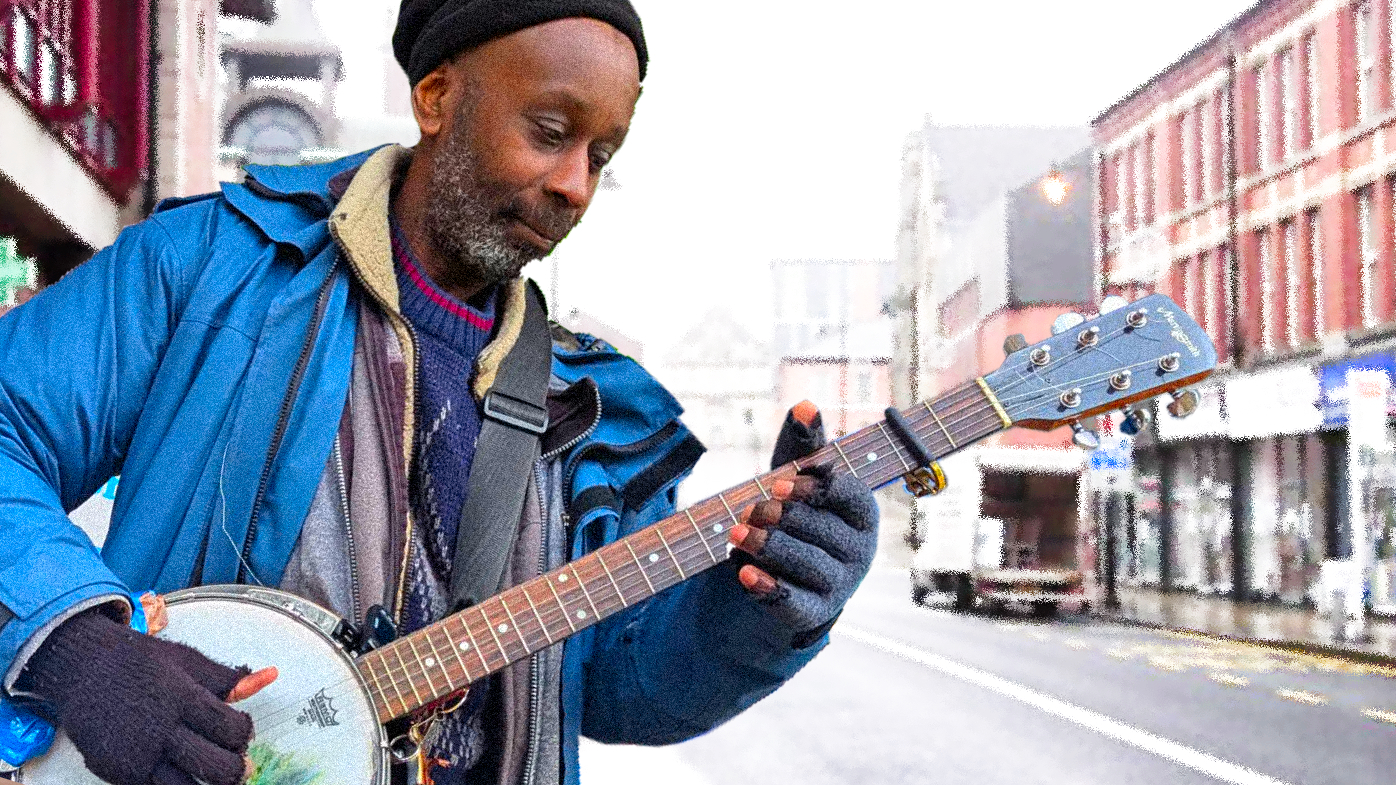
It’s a Friday afternoon in Bolton town centre, and the town sounds like any other. Close your eyes, and you’ll hear pigeons squawking and swearing at each other, teenagers speaking in tongues incomprehensible to those over 21, and a man with a selfie stick beseeching everyone to join his Instagram live.
Listen more carefully, though, and you’ll hear something else: an older sound, an earthy sound. Melodies from another place and time. Follow that sound right to its source – down Newport Street, past the town hall steps, all the way to the shutters where the WHSmith used to be, and there you’ll meet Zacc. A man with music in his bones, Zacc has been busking since 1991, but it wasn’t until 2021 that he started bringing his banjo along for the ride.
“You don’t have to do anything. Just do this! Listen to how great it sounds!” Zacc quotes his first banjo teacher as he fingerpicks a couple of open strings. Both of us fall silent, and let the music linger in the air a little before we continue our conversation. “And I thought… he’s right! It’s just beautiful! I’m a man of faith, and I think… it must be God! He’s given me this instrument to play! It sounds heavenly!”
And heavenly it is. Time slows down every time Zacc starts to play, and everybody around seems to notice. People pause their conversations, look up from their phones, and listen. Spots like this are Zacc’s favourite places to play: short walkways with a bit of passing traffic, but with enough space for people to stop and listen if they’d like. When time expands along this stretch, it affects Zacc just as much as it does his transient audience.

(photograph author’s own)
“Nobody’s paid to see me, so I don’t owe anyone anything. I can spend 10 minutes putting down a drumbeat, and then I might wipe it out and start again. A song I play at a gig which might be seven minutes long might be 20 minutes out here. I can improvise as long as I feel like, I can think: ‘I’m gonna keep playing this bit a little longer…’”
Zacc’s approach is refreshing. In a culture that values novelty and urgency above all else, doing things at your own pace feels disobedient. There is something deeply counter-cultural about busking, and something deeply punk rock about the banjo. Historically, the banjo has been a great friend to rebels in Lancashire, supporting us through everything from wage decline (see The Hand-Loom Weaver’s Lament), to mining strikes (The Miner’s Lockout), to protests that end in flames (Grimshaw’s Factory Fire). When I ask Zacc what his favourite folk song is, he too thinks of something local and rebellious.
“There’s a song called The Manchester Rambler, where he’s singing about how we all have to work, eight hours a day, five days a week. Cuz they’ve got us, haven’t they, on the treadmill? Unless we’re one of the lucky ones that have our freedom. But! On Sundays! He’s free! And so he hikes, he goes out on the highlands and walks. There’s stories in folk songs.”

(source: Red Rose Collections, Lancashire County Council)
And Zacc is a natural-born storyteller. During our conversation, he tells me about his first time busking (“I made £7!”), the time he saw Black Sabbath perform with Ian Gillan (“I mean, what? That’s like putting a Spice Girl up there…”) and the time he went to Copenhagen and busked from morning to midnight. Before this trip to Scandinavia, Zacc tells me, he never fully understood why so many people tell buskers that hearing tunes on the street improves their day.
“I finished late one night, I was sat on a bench having some chips. This man started busking at 12 o’clock – he played loads of covers. I sat there, and thought, I know every song you’re playing. It put a beautiful sound on the street. After that, I got it.”
Standing here now, it’s clear to me that Zacc improves lots of days out in Bolton. As we chat, many people offer a smile, a nod, a wave, a couple of quid in the banjo case. Zacc plays in this exact spot pretty much every single Friday, and for a lot of folks in town, stopping for a chat and a song has become part of their routine.
Strangely enough, when I picture Bolton, I picture buskers. Not the (startlingly few) buskers that are here today, but the ones that frequented the town back in 2006, when I was too small to even glance over the shop counters. I was fascinated by the street performers I’d see on every corner, bearded men with flutes and bagpipes and instruments that I couldn’t name but loved listening to. Every time I saw a busker, I’d be overcome with a feeling impossible for a six year old to articulate – a sense that the world was a vast, vast place, full of so many stories and songs that I was yet to hear. As I got older, I valued buskers for a different reason. They modelled a rare version of adulthood where you are free to do as you please, and are proof that a person can make money by doing the things they love.
“People have this romantic thing – oh, you’re there for the romance! For the sheer love of music!” Zacc exclaims. “Most people, though, are there for the money. You need money to live. The difference is, you don’t have to be there just for the money. I’m here to play to people, and practice. Whatever you learn, you take home with you. If it ever becomes just about the money, I’ll go home.”
But there’s no need to go home, not just yet. There’s no rush, The interview is over, but I stay a bit longer, just for a chat. We talk about Rush, we talk about regional accents, we talk about everything under the setting sun. What a beautiful town this is. What a beautiful life this is.
You must be logged in to post a comment.