
“Quad bike bow hunting. We’ve touched on that, haven’t we?”
It’s a stormy September evening in Bickershaw Country Park near Leigh and my mate Hamish is talking me through his time as a Project Officer for Lancashire Wildlife Trust. He’s going through a list on his phone and so far topics have ranged from arson and joy riding to warbler walks and hot-wired diggers. Quad bike bow hunting for deer does what it says on the tin. “A man got shot in the face with a shotgun at 4 p.m. on the road at the top.”
“My boss was like, ‘Carry on as normal, just don’t approach any lone vehicles as they haven’t found the suspect yet.’ Around that time I was in a shop that got held up at gunpoint too and we all had to hide in the back. I think that was probably the point where I was like: fuck this.”
For three years, ending in the pandemic, Hamish worked as a Project Officer at Bickershaw Country Park, a 250 hectare piece of land that sits on the site of the former Bickershaw Colliery. The colliery officially closed in 1992 and for the 25 years that followed, the site sat unmanaged.
Nature soon reclaimed the area’s former lifeblood back as grass, scrub, marsh, and forest wetland. Pits became flashes (another word for a man-made lake) as if mining had been all but a dream. Hamish’s job was to try and turn the land into a nature reserve by improving the natural habitat and supporting people in volunteering and maintaining the site.

The land has a notable history. Mining in the area dates back to 1830 and in 1972 the site hosted the Bickershaw Pop Festival, a cultural event likened to Wigan’s Woodstock. 40,000 music fans arrived to watch a line-up boasting Hawkwind, The Grateful Dead, Captain Beefheart, and The Kinks. A BBC Archive video suggests it was the first time yoghurt had ever been sold in Leigh.
“No matter who you speak to, they’ll say they were there,” Hamish says, as we leave the Fir Tree Flash Car Park beneath a biblical, slate grey sky of storm clouds, rainbows, and the sinister sepia-tinged embers of sunset. “You’d speak to a 16-year-old on a quad and he’d say he was at the front for Captain Beefheart.”
This evening’s walk is Hamish’s first time back in five years and we’re here to see if much has changed. I’m also here for the stories, which mostly consist of an amusing, whack-a-mole mission to curb anti-social behaviour, manifesting as people shithousing his attempts to put in fences, paths, and other habitat-boosting infrastructure, or just driving over every corner of the park. Throughout, he took it all on the chin with a good sense of humour.
“You’d have these huge grassland areas, that we’d cut and manage, get local farmers in to do the hay. And every year without fail they’d get set on fire,” he says. Locals suggested the clockwork arsonist lived nearby but it was impossible to prove anything. Another time some people hot-wired a digger that had been left on site and rampaged through his newly built paths.
Central to his time at the park was an innate conflict. Here he was, his first job in conservation, trying to encourage more local people to enjoy the park’s warbler population (10 of the UK’s 12 warbler species can be spotted at Bickershaw, including grasshopper and willow), whilst other people wanted to continue what they had been doing for decades: driving off-road vehicles all over it and shooting stuff, possibly warblers.
Beneath stormy skies, we trudge across the park’s lush green floor flecked by blood red bramble leaves, the occasional chunk of wet coal protruding from the floor. We see almost nobody, as the distant rumble of dirt bikes lingers in the air. On the horizon, Hamish points out a murmuration of starlings, something he’d never seen in all the time he worked here.
Parts of Bickershaw feel like another planet. At the top of old slag heaps, great plateaus open up resembling highways. Deers live at Bickershaw, otters are rumoured to. Hamish never got to see a bittern, but they’re thought to be here, among kingfishers, water voles, herons, and a population of Jacksnipe that has been designated as having European significance. The wet woodlands support Willow tit, one of the fastest-declining bird populations in the country.

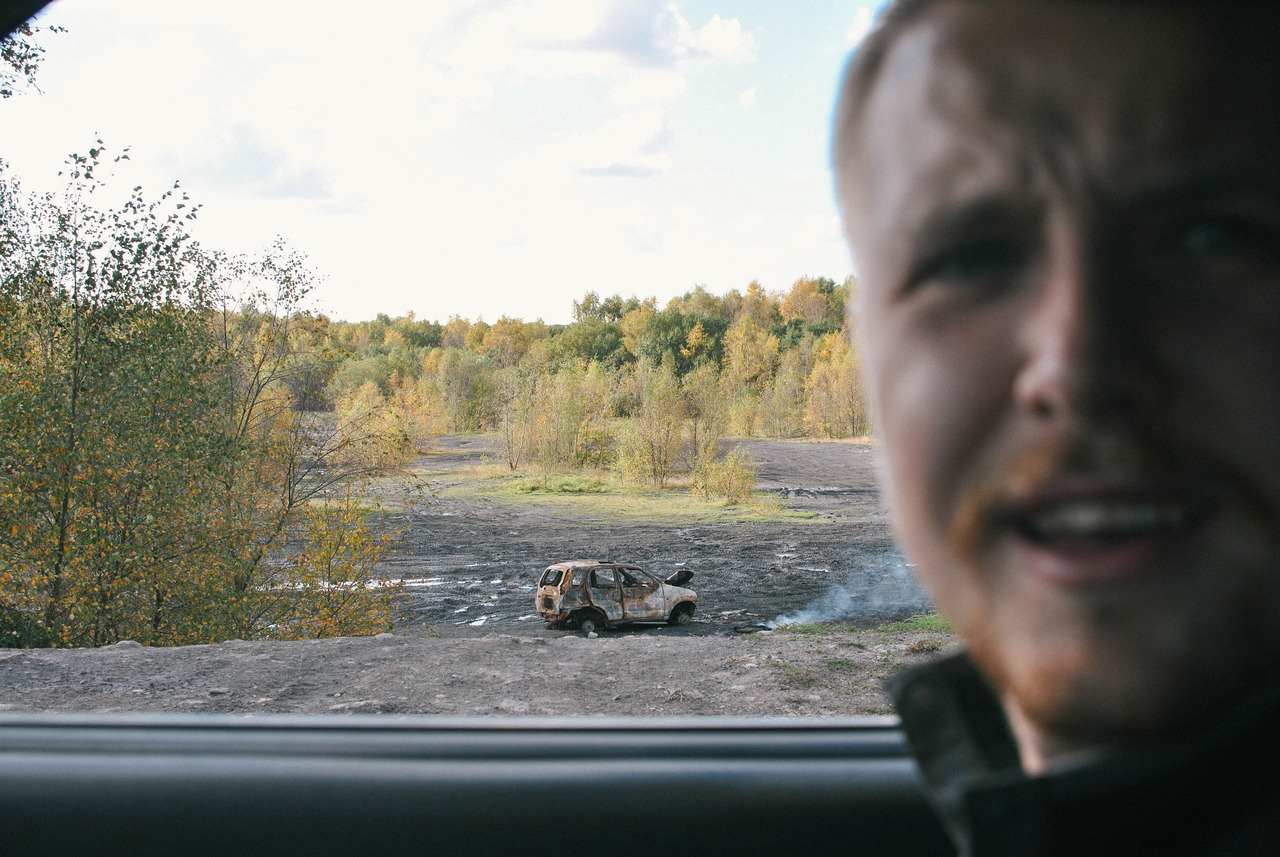
There’s less scrap metal on the site than there used to be. He once drove me around the site and within 20 minutes we came across a smoking burnt out car. Other times you’d find the carcasses of abandoned Land Rovers. Seatbelts hung on trees nearby, part of homemade winches for trying to get them out. The police suggested this was a recreational pursuit for Scouse organised crime gangs, but again, it’s hard to tell.
Hamish is proud of his work at Bickershaw. A moment that sticks with him is when his volunteers cleared up after an illegal rave one weekend without having to be asked. Bags of nos canisters, tinnies, and the odd human shit were swept up by people that wanted to protect the area because they themselves had spent their weekends trying to improve it, building their own relationships with the land.
At the end of 2022, the newly renamed “Flashes of Wigan and Leigh”, a 700 hectare expanse that includes Bickershaw, was officially declared a National Nature Reserve. Significant for many reasons, but perhaps most notable for the recovery of nature in a place where at one point in history, the current landscape must have seemed impossible. For Hamish, already off on his wetland conservation trajectory, it was a satisfying moment from afar.
As we walk back to the car park, I make a mental note to bring him back again in five years to spend a whole day here. If anyone deserves to see a bittern here, it’s him.
You must be logged in to post a comment.