
all illustrations by Gabriel Carr
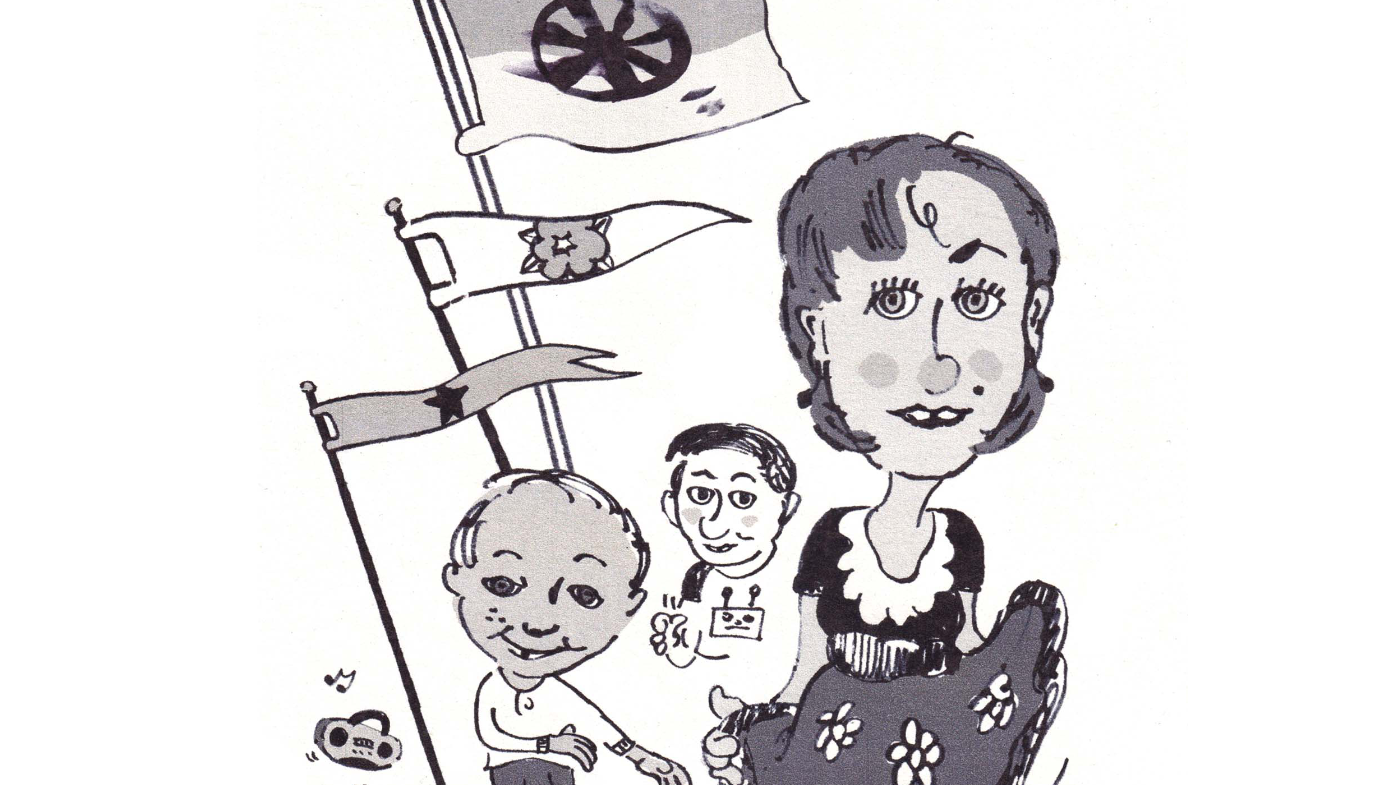
Bolton Socialist Club is a corner of the Roma nation. I arrive at the start of today’s session, the space yet to be assembled. Angelo, a young teenager, enlists me to help move tables and chairs and ready the room for dancing. Alongside the Socialist Club’s banners celebrating mass trespass and solidarity with Palestine, we hang the Romani flag, a red, 16-spoked wheel upon bands of blue and green. The Roma are a people without territory, but this afternoon’s rehearsal in Bolton is proof they carry their nation with them, summoned wherever they have space to express their shared culture.
The floor cleared, the younger members of the group fill it with dancing immediately. A table is set with drinks, food, and a portable speaker which blasts traditional Roma music. KaskoSan Roma Charity have been creating this space for local Roma people, supported by Bolton Socialist Club, for two years, an extension of their work in Bolton which began in 2013.

The children dance, run, shout, clamber on furniture. Focus arrives in the figure of Michael, their dance teacher. “It’s quite a mixture, Hungarian Gypsy folk dance. It’s mixed up from different ways, you’ve got Romani dance, you’ve got Hungarian dance, it’s a mixture, not just one specific dance. I could describe it many, many ways. Passion! 100%. Passion, feelings, stress relief, and enjoyment, entertainment. Pride. Physical. Culture.”
When I chat with Michael, he is light, always slightly in motion as if hovering on the breeze. The dance floor transforms him. His loose physicality transforms into a purposiveness which floods his frame. His shoulders are broad and open, his head high, his forearms hang in front of him delivering precise claps and clicks which accentuate the offbeat of the music. The footwork in this style of dance is spry and agile; Michael’s palms slap his thighs, heels and calves along with the beat, his feet reaching the height of his hips. The effect is hypnotic and frenetic at once.
“How does it feel? The most simple word: amazing. On a daily basis I don’t get the chance normally to do this, cause I’ve got different jobs and everything. When it comes to this, I just feel free. You don’t think about anything when you’re doing it. You forget all your problems. For the sake of life, I dance for the sake of a minute. Everything goes for that minute. You forget all your problems. When I dance I don’t think about anything else.”
Michael is a charismatic and careful teacher, coaching his young students in a mixture of English and Hungarian, clicking his fingers to keep time, each tick crisp like a snapping twig. His skill as a dancer is complemented by his warmth as an instructor, patiently repeating steps and working one-to-one with members of the group. I begin to sense Michael is always only barely suppressing his impulse to dance. Throughout the session, flurries of expressive steps, slaps and claps burst from him, punctuating his instruction.
Dance has always been part of Michael’s life, passing on the tradition through teaching a natural conclusion. “I’ve always thought this is a little bit of a mission of mine. When I was so small, I was always dancing. I used to dance in family events, going to birthday parties and all these.” Michael also works as a driving instructor, is there a link between these two different teaching roles? “I’m passing on knowledge aren’t I? In that case I’m passing on my driving knowledge and my road safety knowledge. I do feel a connection between the two. At this very moment I do love my job and I’m passionate about my job. And I love teaching dance as well, I feel like they’re in the same boat for me.”

He’s modest about the subject, but when he was younger, Michael belonged to a dance troupe which toured Hungary and Europe. When talking about it, he turns again to discussing the importance of passing knowledge to the next generation. “On a professional level, I’ve had the luck in my life that I’ve managed to learn from dance teachers – certified dance teachers – I’ve managed to gather it from different places. Back int’ day, anywhere I went, to festivals and all that. You bumped into people who knew how to dance.
“I want to make sure anywhere the kids go, they can show what they know. They can show, ‘I’m worth something’. It’s showing a bit worthy, when you’re dancing. ‘Look, I’ve got some sort of talent which I can show you.’ For me it’s important to pass it on to the youngsters. Anything I learnt, it can be took on, it can be carried on. So the culture carries on going, so it doesn’t stop.”
Testament to the warmth of the environment created by KaskoSan, the young people are totally at ease at the same time as treating their learning very seriously. They dissolve into mucking about in the breaks but when Michael calls them back to rehearse, they assemble like any disciplined professional troupe. When they learn I am writing an article, some of them insist on their voices being included. I’m happy to oblige.
Janos: “I come to this club because I enjoy myself here. I just want to tell you what the word, kasko san means. When two Gypsy people meet up, they don’t say ‘What’s your name?’ they say ‘Who’s your dad and who’s your mum?’ So that’s what kasko san means.”
Shanel: “Because I like dancing. It makes me feel happy.”
Angelo: “This is a really nice and good opportunity to learn how to dance and make loads of new Roma friends in Bolton. We’re just trying to show our culture to people and we’re just trying our best to get everyone invited. I’m really enjoying how Michael is teaching us, he’s really good at teaching us.”
While the rehearsal continues, I speak to Juice, one of KaskoSan’s founders, about the significance of the space they have here at the Socialist Club. “As an East European Gypsy person it’s pretty hard to get permissions to rent out places, especially for cultural activities.
“In the UK, YouGov measures the least liked communities, and every time they run this research it’s always the Gypsy, Roma and Traveller community that comes out to be the least liked – I would call it most hated – community. So therefore these families do not have a space to safely celebrate their identities. The Romani identity we all have stays hidden and isolated. It’s a stigma, to be a Gypsy. When we go to schools, when we go to our jobs, people normally say, ‘I’m Hungarian, I’m Romanian,’ you identify with the mainstream identity from Eastern Europe, but you wouldn’t say that you’re a Gypsy. Many have this self-perception, where they see their Romani identity as inferior. They don’t call their home language a language, it’s just ‘Something we use that we don’t talk about’. But we create a space where we can be proud of this.”

KaskoSan creates space – the room is made Romani by the hanging of the flag, by the music, the language, the dance, the culture and the family groups who turn up together. The Roma nation is conjured by these cultural practices. Juice, with decades of experience as a Romanes interpreter, extends the idea into language. “You can create a space for your Romani identity anywhere in the world, just by using the language. The language is constructed in a way that within one sentence there are five thoughts. With just two or three words you can have a deep meaning. It’s like a code language. When you utter those words, you create the space straight away.
“You can create that Roma space, not just by the language, but also by dance, by the way you make food, the way you serve food, the way you eat, the way you conversate, the way you sit, the way you stand, the way you keep eye contact. We’ve got lots of ways, the Romani ways, and there is a word for that, it’s Romanipe. And when you do these ways, that’s what constitutes the Roma nation.”
I take the question to Michael, what is the Roma nation? “Somewhere you can be yourself. Roma people are good at that. They see the way you are and they say, ‘Yeah, he’s like that. Fair enough.’ You don’t need to be anything else than what you are. I quite love that. I just feel free. So free. That’s it.”
You must be logged in to post a comment.