
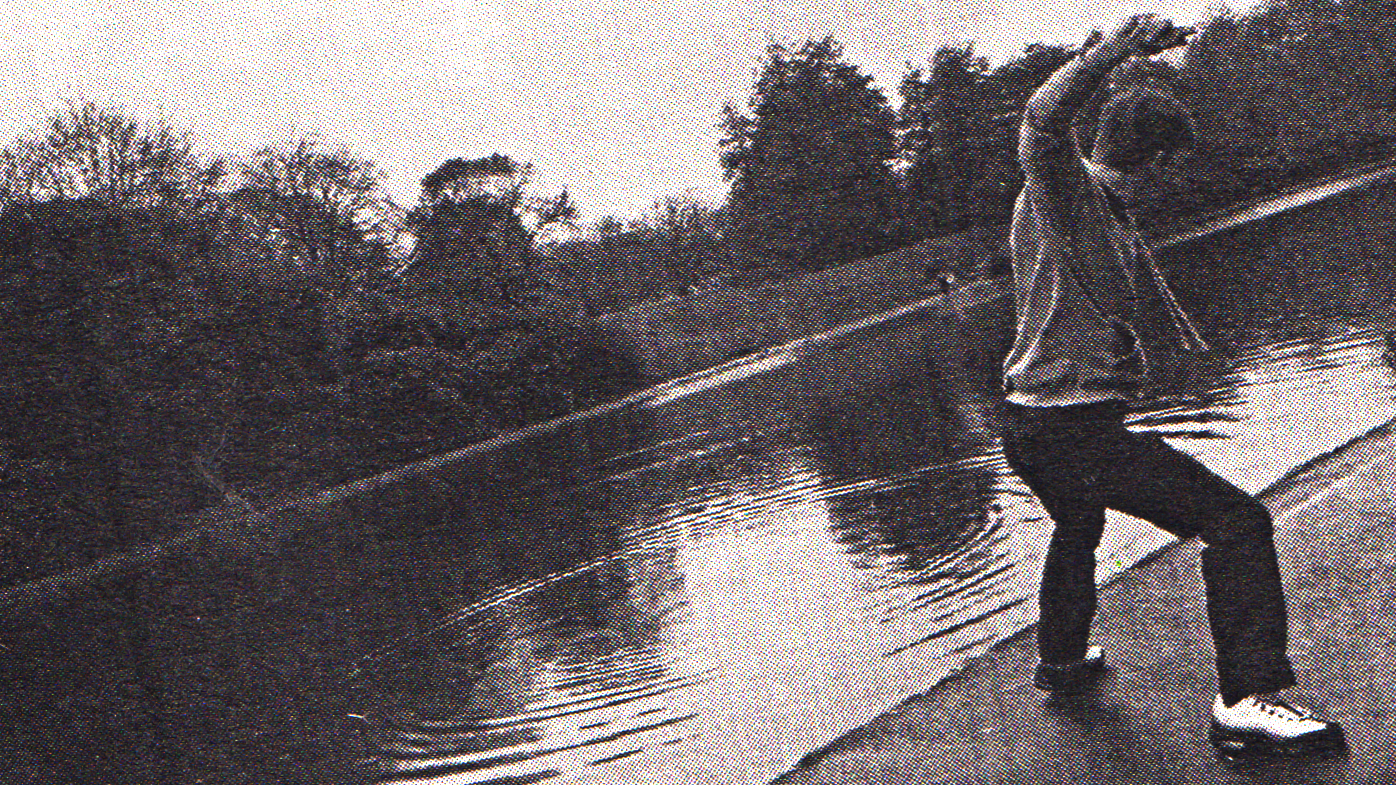
A perpetual city dweller, I’ve learned to love the scraps of nature afforded to me. In the summer, we sit on ugly picnic blankets from Home Bargains, eat sweaty packets of salami, and release the plastic sack of wine from its box, keeping it under a bag of ice to cool, to watch coots chase each other, skirting across the surface of the water, and geese pull tongues at empty hands. Instead of Attenborough’s narration, music you’d hear played at a working class Holy Communion party blares through a Bluetooth speaker, and elder Scousers offer advice to young fishermen.
My bike’s brake pads are deteriorated, so I guide it by its stem around the edge of the lake in Liverpool’s Sefton Park. My crotch is soaked from my wet bike seat. I turn my face downwards to look over the top of my rain-speckled specs to see. A glass bottle of a cold Magnum in my pocket for the ride home perspires. It’s warm for this time of year, and as I approach the Boathouse Kiosk, my glasses steam up.
Through the filmy walls of the Kiosk, I recognise the founding members of the Liverpool Stone Skimming Society – Luca Killick, 19, and Joel Lewis, 21 – by Luca’s moustache, and I mouth “I’m here to meet you,” while pointing at myself and then at the two of them. They exit, carrying with them the bitter aroma of roasted coffee, and extend their free hands. My hands, like the rest of me, are wet. I apologise, and we walk around the environs of the lake to pick a spot for skimming stones.
Before learning about the existence of the LSSS, currently a society of two, I’d only seen people whimsically skim stones on the telly. I asked how Joel, a competitive arm wrestler, in his Scouse standard Nike 110s came to skim stones with Luca, a musician in smart shoes and bootcut jeans. Joel says, simply: “It was no fun solo.” When asked what prompted them to turn their pastime into a society, they surprise me by saying: “We actually wanted access to the film room at our university but as of yet they aren’t viewing us as a legitimate society,” and so, they opened up their community by announcing its existence through the launch of an Instagram account.

Their bio reads: “We are The Liverpool Stone Skimmers, society of societies; look on my works, ye Mighty, and despair!”, a reference to the poem “Ozymandias” by Percy Bysshe Shelley. Standing in the drizzle next to the vast expanse of the lake, dimpled by raindrops and dragged by the V formations of mallards, the lads unload a sack of stones eroded by weather and time. I think about the choppy waters that claimed Shelley’s life and the shattered remains of Ozymandias’ statue. Their use of this sonnet, inclusion of a Bible verse in their first post, and choice of song “Breathe (In The Air)” by Pink Floyd, are tongue-in-cheek, though inadvertently encapsulate stone skimming’s connection to the natural world.
The instant popularity of their videos reflects the growing collective interest in obscure hobbies from so-called olden days, with stone skimming itself being an ancient activity. With bot-written articles, plagiarised AI “art”, and Google’s AI Overview destroying any semblance of usefulness, the internet is becoming increasingly unusable. This, combined with digital demons and the psychological effects of being online, is fostering a yearning for simpler times away from the keyboard.

Like Shelley, these lads seek calm. In the desolate landscape of insecurity and individualism, they’re attempting to create a non-exclusionary community of outliers, because as Joel states: “Outliers are the more interesting ones.” Out skimming, apart from the occasional disgruntled fisherman, they are met with compliments and wonder from people of all ages, which they hope will materialise into participation.
Patiently, they teach me, someone who hasn’t thrown anything other than arse and my back out in a great many years, to skim. My hands cup the flat stone, fingers curling around their eroded edges. Panicked by oncoming foot traffic, I stumble and the stone I attempt to skim plops once through the water’s surface, sinking, undignified, to the bottom. Undeterred and encouraged by the lads, I try and try again. Three bounces is my record, a far cry from their skims that reached beyond the opposite edge of the lake over the path and into a bush.

They offer me their umbrella, but I refuse to suffer the embarrassment of fighting with it should it be turned inside out by the wind. The rain didn’t bother me, nor did it appear to bother them. The single-use stones are transported from elsewhere due to a lack of suitable ones nearby.
The LSSS tell me they make frequent trips to Scotland (the Slate Islands, to be exact) for the ideal skimming equipment. Once brought to the North West and tossed they belong to the lake of Sefton Park. This is a pastime that is transient and without pretence. Near where we are standing, Joel notices an old stone at the bed of a shallow part of the lake, a ghost of a past skim.
Before we part ways, I ask what film they’d screen should their society be accepted. “Koyaanisqatsi,” they answer, “it’s a 1982 film that’s, like, anti-technology.” And so the circle is complete – it’s hard to think of another hobby as anti-tech as chucking hunks of minerals into bodies of water. Appropriately, it’s a film that is the antithesis of our current habits of content consumption, with footage playing in slow motion and time-lapse without narrative or dialogue.

dir. Godfrey Reggio
I leave the Liverpool Stone Skimming Society filled with a hope for the younger generations that you won’t acquire without spending time with them in person – a hope that you can only glean after abandoning the screen, getting soaked, and grasping a rock. Like our many ancestors did, you stand by the waterside with an organic rocket in hand. You breathe, extend, and let go.
You must be logged in to post a comment.