
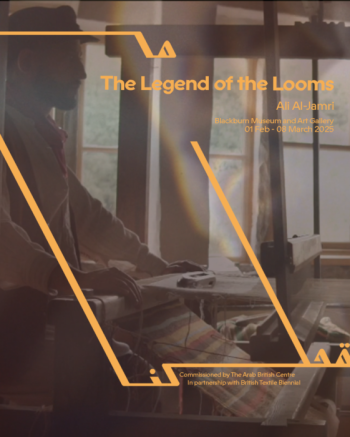
The Legend of the Looms
Ali Al-Jamri
Exhibition & Film
Blackburn Museum & Art Gallery
February – 8 March 2025
Whilst weaving, heritage, and protest get their due credit on the plaque describing Ali Al-Jamri’s new installation, Jerry Zucker’s Ghost (1990) arguably deserves just as much of a hat tip.
Directed by Ricardo Vilela, Legend of the Looms forms the main part of a triptych installation. It is listed at 18 minutes, but feels much shorter. Viela’s film is incredibly compelling. It uses quick cuts and slow motion tastefully, and has some beautiful close up shots of woven textiles. Mohammed Jassim’s camerawork elegantly shows off a caged songbird, the landscape of Rossendale Valley, and the work of weavers from Al-Jamri’s family in Bahrain. The music and sound design by Patryk Krol leaves enough room to be unobtrusively forgettable. All this work comes together in a film written and starring Al-Jamri about two weavers from his respective homelands.
The triptych is then completed with a display of nine objects behind a glass panel, and a gigantic woven textile, Both Their Natures, created by Ibukun Baldwin. Each of the nine objects are interesting, and all feature in the film in clever ways. They are neatly organised but cannot escape the sterile nature of their display. Meanwhile, Baldwin’s piece is superb. It is interactive, interesting, and beautiful. It looks smaller in real life than on film, but nonetheless forms the best part of the installation.
Legend of the Looms is framed by Al-Jamri rediscovering his own interest in the heritage of weaving. Two apparitions appear and talk about their lives. It is awkward when Al-Jamri, playing both ghosts, tries to operate the historic loom. It compares poorly with the professional work of another weaver. Al-Jamri’s writing is fine, with a few pithy lines. His history of weaving is male-dominated, and women take their typical place as motivators for men’s work: “our wives wanted food”.
Al-Jamri explores the creation of weavers as a class and a culture. The Rossendale weaver describes economic extortion. His Bahrainian counterpart details physical coercion, encourages his friend to “find God”, and emphasises weavers’ role as preachers in Bahrain. This is countered by the Rossendale weaver, who cites the use of poetry for recreation. The contrast here is between the creation of a class, through economic or physical abuse, and the promotion of a class consciousness, through preaching or song.
The cultural discussion is the most lively part. It is nuanced and full of poetry from both places. The back and forth in these moments is excellent and Al-Jamri delights in wordplay.
However, the piece never really gets away from the idea of a so-called noble poor. Whilst the presentation is for general audiences, Al-Jamri may have been overambitious. In particular, bringing in Peterloo did not seem necessary and overcooks the piece into far too sanctimonious a fashion for my own tastes.
On the whole, this is a fine installation. It features a magnificent textile and a pleasing collection. Al-Jamri’s film has grand ideas, good execution, but, like Zucker’s 1990 sensation, it all feels a little corny.