
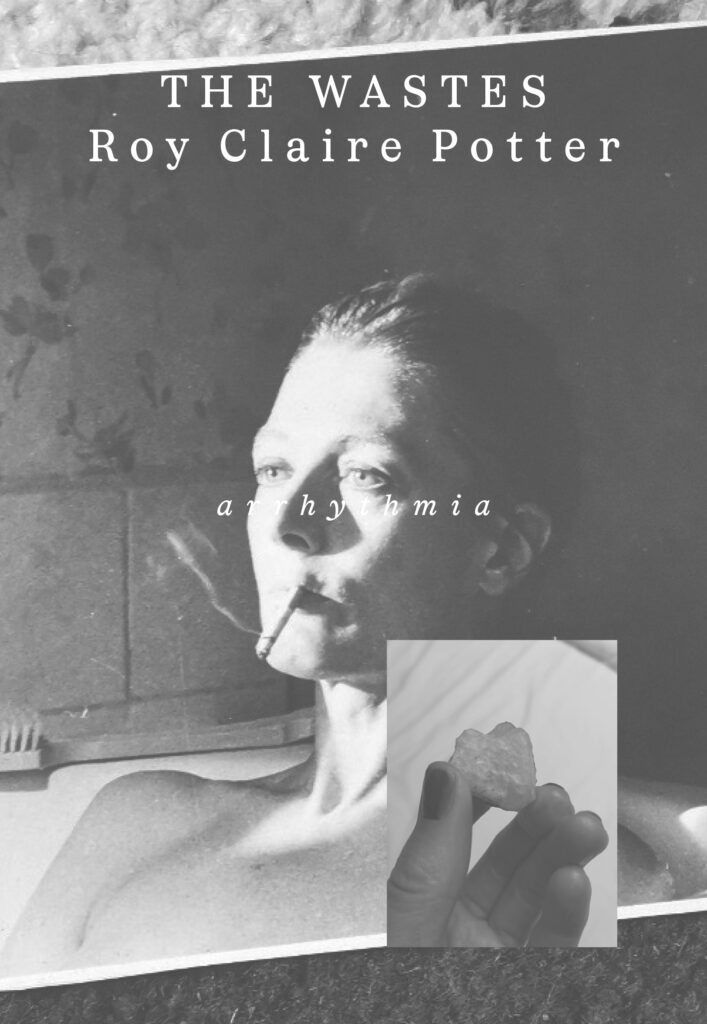
Roy Claire Potter
Published on Bookworks, 1st March 2024
£14.00, ISBN: 9781912570201
Grief is reflective. Inward facing. It topples identity. It topples time: tenses get confused. She is… she was. It gnaws at the wooden structure of reality. Death upends your plans.
Belonging is an unstable state. It should be inherent, but we can’t kid ourselves. It is dependent on networks of people and places. Subjugated by external forces. It can’t be forced. It can only be felt.
Roy Claire Potter’s The Wastes maps topographies of grief and belonging on urban landscapes and rural land. Potter’s artistic practice, particularly their work with sound art, found text, and oral histories, shines through this narrative. It weaves offhand conversations, grocery receipts, house bills, value systems, soft and hard water, routines of labour, routines of unemployment, and inherited family rituals (hand-in-hand with familial fears) into an honest tapestry that spans across the east and west regions of the North.
Cities and towns, provinces and places: Huddersfield and Edge Hill, Broad Green, Saltburn Beach and Morecambe Bay, Levenshulme, Hebden. An assemblage of accents and rituals, landscapes and particularities that are seldom hidden in literature. Or, if they are unearthed, they are the punchline, the scapegoat, the ugly sister.
The pace is set by the chugging of a train, boarded at Liverpool, destined for Leeds. Journeying to grid reference 3499 of the South Pennines Ordnance Survey map: The Wastes. She questions the origin of its nomenclature. Was this infertile land? A place with bad soil?
Her pilgrimage is punctuated with vignettes of the past. She slips into different names, wears different origin stories, dons different working roles. She exists in relation to extrinsic factors, the city she’s in, the people she’s in close proximity with, her relationship with her mother.
The one time our narrator experiences a solid state of identity – a feeling of belonging – is when she meets Jo, a butch lesbian and friend of the daughter of the woman the narrator cares for. The woman is an elderly Jamaican Seventh-day Adventist who envisions Jo as “the devil”. Prior to this meeting, the narrator spins stories about herself to those around her, but connects with Jo and her friends. They see her, she sees them, beyond the surface: “the fact of me was apprehended by every one.”She doesn’t need to hide behind any pretence – a common survival tactic for the working-class, particularly its queer contingent.
Potter resists unravelling the messy, binding knots of place, family, loss, and selfhood. Schisms of unmarked paper encourage us to slow down, to digest the words, to reflect, to ponder. Instead of tidy conclusions, there’s an image of a pair of seats on a fast-moving train, a bed with the imprint of the morning sun through a windowpane.
The Wastes are not a destination. They are a process. Something which takes shape in memory, bigger and more imposing than its material form. There is no ending. Just the start of another journey.